About Electrophaes corylata (Thunberg, 1792)
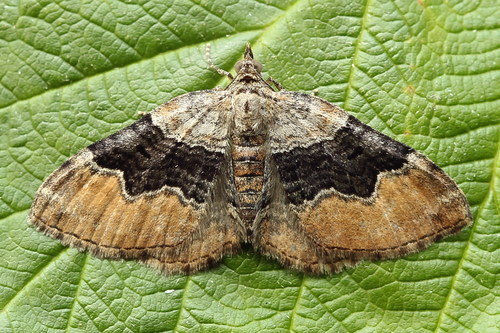
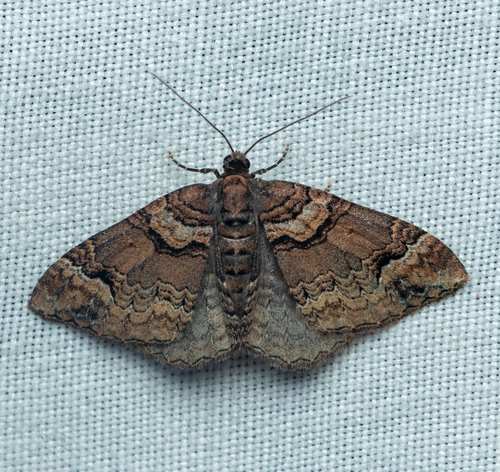
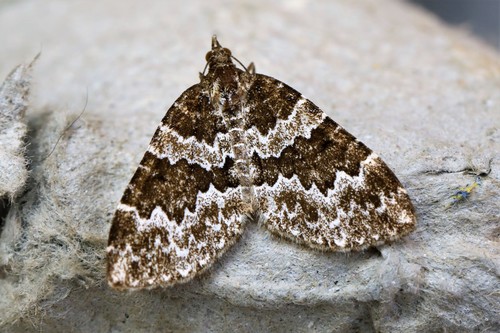
Electrophaes corylata, commonly known as the broken-barred carpet, is a moth species belonging to the family Geometridae. Carl Peter Thunberg first described this species in 1792. Its distribution extends from Spain across western and central Europe, and through the East Palearctic region to Japan. In the north, its range reaches Fennoscandia, and in the south it extends to Italy and the Balkans. It is not found in Portugal or Greece. This species prefers habitats including beech forests, birch forests, bog areas, mixed bushy forest edges, orchards, and semi-dry grasslands. The wingspan of Electrophaes corylata measures 22–30 mm. The forewings have a ground color that appears in varying combinations of dark brown, white, and reddish brown; some specimens have predominantly olive coloration. The median band of the forewings is narrowed, and may sometimes be interrupted. The outer cross line that forms the boundary of the central midfield is strongly serrated. The marginal field of the forewing is obscured, and is crossed by a distinctly toothed white wavy line. A bright spot is present at the forewing apex. The hind wings have a shimmery grey appearance, with a dark cross line and a central spot. This species produces one generation of moths that fly from May to June. The larvae of Electrophaes corylata feed on a wide variety of tree and bush species.