About Electron platyrhynchum (Leadbeater, 1829)
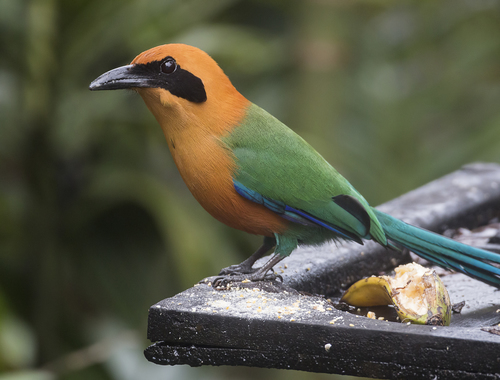
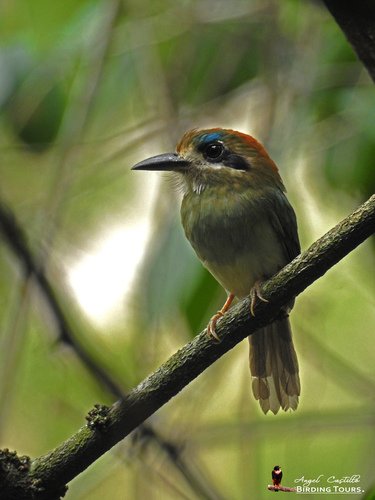
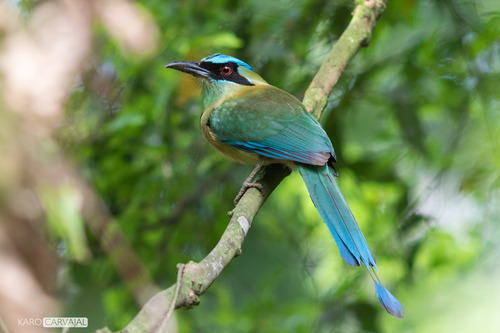
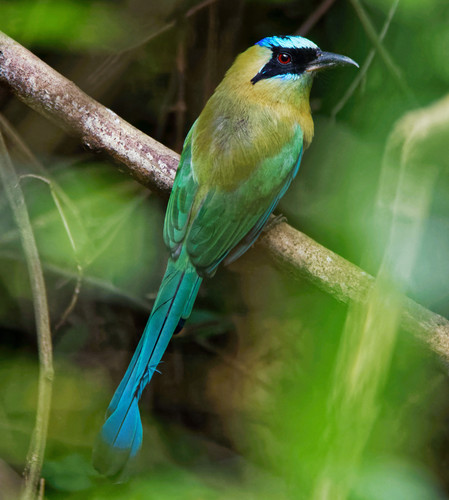
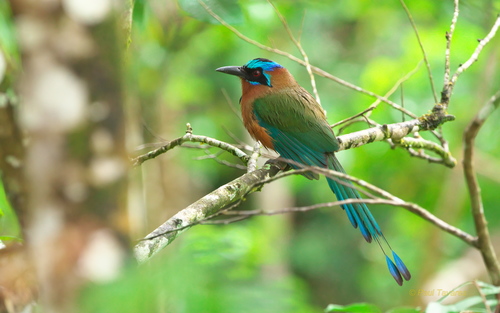
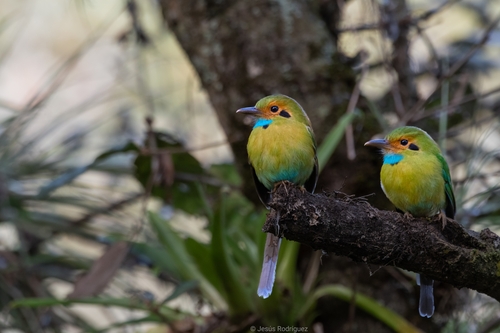
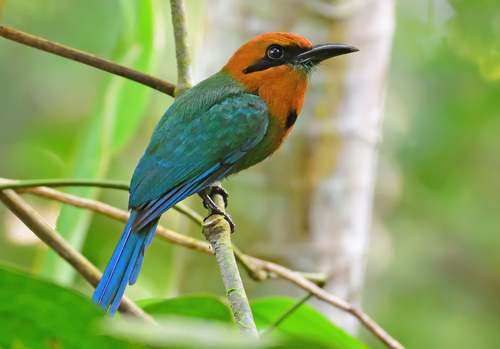
Electron platyrhynchum, commonly called the broad-billed motmot, is a member of the Momotidae family. It reaches around 12 inches in length, and averages 60 grams in weight, making it one of the smallest species in its family. It has dark eyes and dark feet. Most of its upper body, including the head, neck and chest, is colored cinnamon-rufous. It has a black patch covering the cheeks and auricular area on either side of the head, plus an additional black patch at the center of the chest. The lower half of its body is more greenish on the upper portion and becomes more blueish toward the bottom. This species has a long tail that gradually changes color from blue to black. It also has two racquet-shaped central tail feathers that are much longer than the rest of its tail feathers. As its common name suggests, the broad-billed motmot has a broad, flattened bill. The bill is black, has serrated edges, and bears a keel on the upper mandible. This species shows no sexual dimorphism, meaning males and females have identical appearance. Juvenile broad-billed motmots are duller and darker than adult birds. Juveniles also have white markings on their bill and a blue-green streak running over the eye. The broad-billed motmot is almost identical in appearance to the rufous motmot (Baryphthengus martii), but can be distinguished by several key traits: it is smaller, has a larger black chest patch, and has a blue-green chin. The broad-billed motmot’s range covers eastern Central America from Honduras to Panama, and extends into multiple countries in northwestern South America, including Colombia, Ecuador, Peru, Bolivia, and Brazil. It lives in humid forests, warm lowlands, and foothills, and occurs at elevations below 910 m (3,000 ft). In Costa Rica, broad-billed motmots lay eggs between February and May. This species has an average clutch size of 2 or 3 eggs. Broad-billed motmots are socially monogamous, and nest in burrows dug into earthen banks. Both parents take turns incubating eggs, though females typically take longer incubation shifts. The exact length of the incubation period for this species’ eggs is not currently known. Hatchlings are born naked and blind, and both parents share the responsibility of feeding the young.