About Elatostema rugosum A.Cunn.
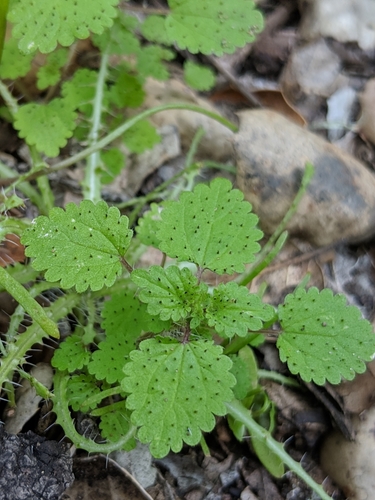
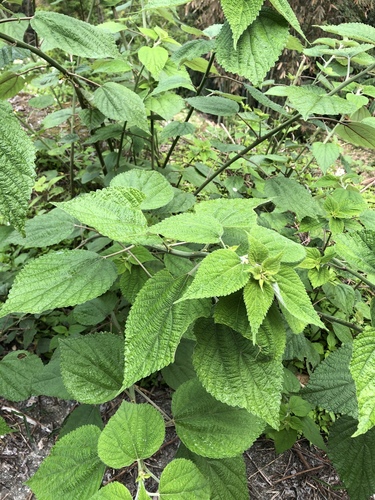
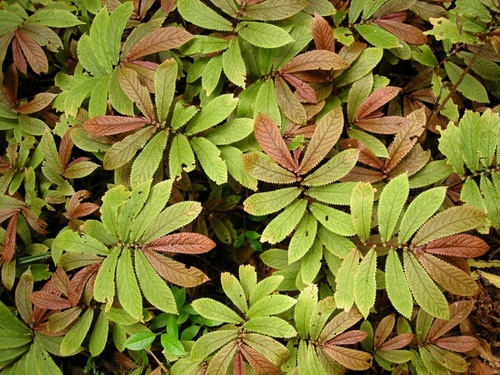
Elatostema rugosum A.Cunn. is a New Zealand plant with the common name begonia fern, given by Europeans because of its appearance, despite not being related to either begonias or ferns. Its leaves are mesophyll leaves: young leaves are often reddish from anthocyanins, and mature leaves range from purple and green to bronze. Mature leaves measure 8–25 cm long and 2.5–6 cm wide, have prominent teeth, are wider on one side of the midrib, are stalkless, have dark veins, curve toward their narrower edge, and have a wrinkled surface. This wrinkled texture matches its specific epithet rugosum, which comes from the Latin word "ruga" meaning "wrinkle". The leaves are pinnate, alternate, and often grow in a single flat plane. Plants typically grow very close to the ground at ankle height, but commonly reach knee height, and can grow taller since stems can reach up to 1 meter tall. Stems are juicy, bend at the tip, have a woody base, spread across the ground, and root where they touch the surface. Like many native forest plants of Aotearoa New Zealand adapted to local native pollinators, this species does not produce large, colorful flowers. Its small flower clusters are protected by a membrane, emerge at the base of leaves, and grow in clusters up to 2 cm long. These flower clusters are generally reported to be unisexual, but both sexes often occur on the same plant. Cheeseman (1925) notes that both male and female clusters can grow on a single plant, while Moore and Irwin (1978) describe the sexes as generally occurring on separate individual plants. Male flowers are produced in large quantities, are often partially hidden by bracts, and each sits on a tiny stalk. Female flowers mostly lack a stalk, have thinner bracts, and their stigmas form small tufts. Fruits are tiny, around the size of a sand grain, and brown. Seeds inside the achene are 0.6–0.8 mm long, and the achene itself is 0.8–1.0 mm long. Seeds are dark, while the smooth, elliptic to ovate-elliptic achene is light colored with dark projections; the achene has a sharp tip and a rounded base. This species is endemic to New Zealand, and it is the only Elatostema species native to New Zealand. It occurs naturally only in the North Island of Aotearoa. It is most common in the northern part of the island, and ranges south as far as the Tararua Range. It is not naturally found in the South Island, but it can survive in gardens as far south as Christchurch when planted under trees with protection from frost. It prefers to grow in wet, shaded forest environments, and is often found along rivers and streams, in gullies, and cascading down cliffs beside waterfalls. It occurs at elevations of 1000 meters and below. The species flowers and produces fruit from September through May. iNaturalist observations record flowers in all months except February, March, and May, with four flowering observations in June, two in July, and seven in August. Its seeds disperse via water and ballistic dispersal. Seeds can germinate in cool or moderate temperatures. For propagation, seeds store easily, and division is also an effective propagation method. Māori traditionally used the leaves of this plant, called parataniwha, to wrap kūmara when cooking it in a hāngī to add flavor.