About Elatine hexandra (Lapierre) DC.
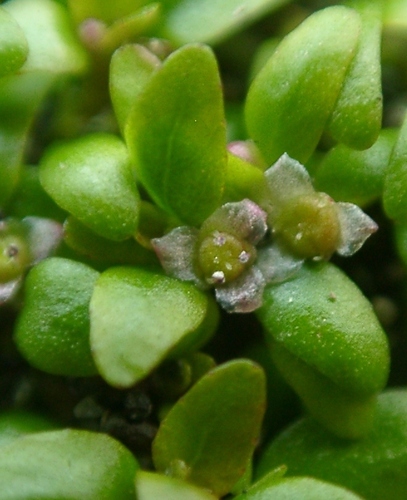
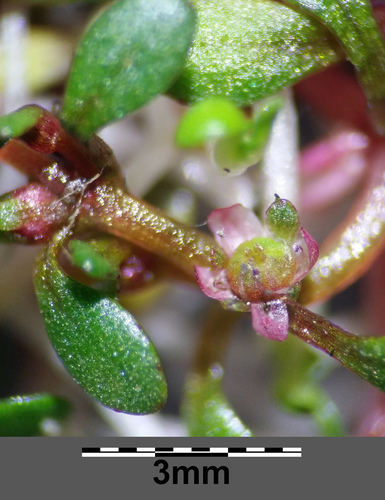
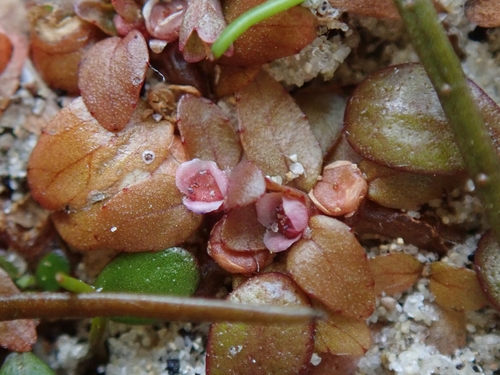
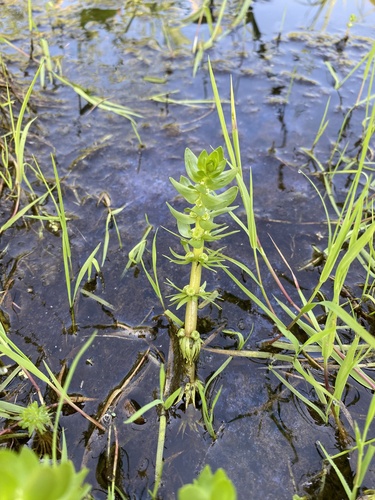
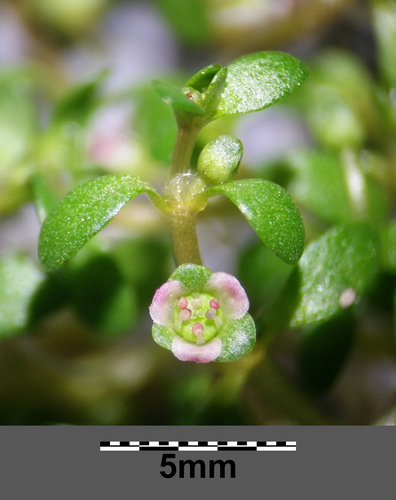
Elatine hexandra, commonly called six-stamened waterwort, is a small herb that can be an annual or a short-lived perennial. It has creeping stems reaching up to approximately 8 cm long that root at their nodes. The entire plant is glabrous, with opposite leaves that range from elliptical to spathulate. Each leaf is around 7 mm long, borne on a short petiole, and has a tiny black hydathode at its tip. Minute stipules are present at the base of the leaf stalks. When growing under water, the stems and leaves are typically yellowy-green; when exposed on bare mud, they turn bright green or reddish. Flowers are most often solitary, but sometimes form short cymes that grow from leaf nodes. Each flower has three sepals, occasionally four, and the same number of pinkish-white petals. It has six stamens and 3 to 5 styles. The flower stalks, or pedicels, lengthen as the fruit matures, and the mature fruit is a four-valved capsule. The seeds are cylindrical, brownish, slightly curved, and up to around 0.7 mm long.
In Britain and Northern Europe, six-stamened waterwort is most easily confused with Elatine hydropiper. E. hydropiper can be distinguished by its absent or very short pedicels and strongly curved, horseshoe-shaped fruit. Counts of flower parts are not a reliable identification feature, since E. hexandra occasionally has 4 sepals, 4 petals and 8 stamens instead of the typical 3 sepals, 3 petals and 6 stamens — a variation that also occurs in E. hydropiper.
Six-stamened waterwort is distributed across most of Europe, with its eastern range limit in Poland and Romania. Its range may extend just into North Africa, and stretches westward to the Azores. This species generally grows in lowland sites. It has been recorded at 440 m at Lough Ferta in Ireland and 425 m at Llyn Gynon in Wales; an old record from Scotland at 490 m has never been verified. Globally, its conservation status is Least Concern, but it is considered rare and threatened in some regions including Picardy and Île-de-France. In every British county where it occurs, it is classified as an axiophyte, a plant of conservation importance, due to its preference for low-nutrient water bodies.
This species grows in clear-water lakes and pools, typically with slightly acidic water and low fertility. Its Ellenberg values in Britain are L=7, F=10, R=5, N=4, and S=0. It can grow at depths up to 3 m in very clear water, but more commonly grows in water around 10 cm deep. When it grows submerged, its flowers are cleistogamous: they remain closed and self-pollinate. When plants are exposed on bare mud during summer, flowers open normally and are pollinated by insects.
Salisbury studied the species' fruiting biology in 1964. He found that a typical seed capsule holds around 36 seeds, roughly 12 per carpel for three-carpel flowers, while flowers with four carpels can produce up to 79 seeds. He calculated that a single plant growing on exposed mud can produce as many as 27,000 seeds, while submerged self-pollinating plants produce far fewer seeds. This difference is an adaptation that lets the species respond quickly to favourable conditions during occasional dry summers. Seed germination rates are strongly tied to exposure to bright sunlight. The seeds do not float, but can remain viable for many years when submerged under water or buried in sediment. It is a useful aquarium plant, since it is fast-growing while staying small in size.