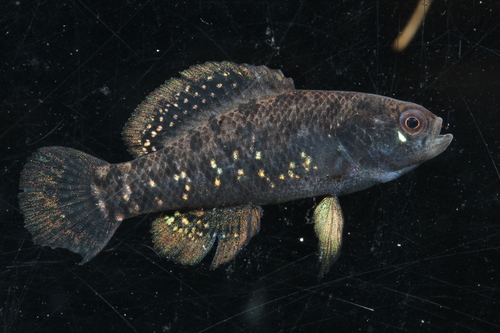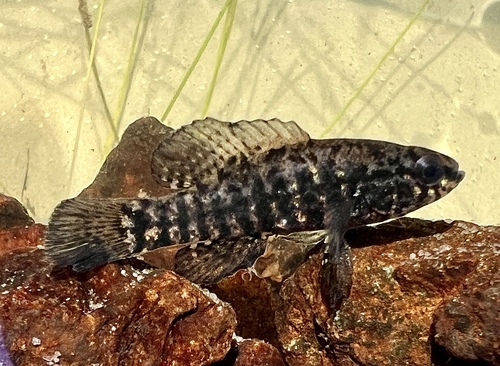
About Elassoma zonatum Jordan, 1877
The banded pygmy sunfish, Elassoma zonatum Jordan, 1877, is a species of pygmy sunfish endemic to the United States. Its range spans from Indiana and Illinois south to Texas, and east to the Atlantic coast. This species reaches a maximum total length of 4.7 cm (1.9 in), though most individuals do not exceed 3.5 cm (1.4 in). Banded pygmy sunfish are neotenous, meaning they retain juvenile characteristics after reaching sexual maturity. This species was originally classified in the cichlid family. Researchers Hay, Jordan, and Gilbert later proposed it was an intermediate form between pirate perch and the centrarchid sunfish family, so it was placed into its own distinct family, Elassomatidae. The 5th edition of *Fishes of the World* treated this group as a subfamily of the sunfish family Centrarchidae, while more recent authorities have restored it to its status as a separate family closely related to Centrarchidae. The banded pygmy sunfish is a small fish that can inhabit rivers, streams, lakes, ponds, and swamps. It is historically restricted to the continental United States, with its overall range remaining largely unchanged aside from minor contractions caused by habitat loss. Historically, it was native to the Mississippi River drainage system and the Gulf coastal plain region. Currently, it occurs from the lower Roanoke River drainage in North Carolina south to the middle and southern parts of the St. Johns River in Florida, west to the Brazos River drainage in Texas, and north to the lower Wabash River drainage in Indiana and Illinois. Like other members of Elassomatidae, it prefers slow to still water with high sediment content, such as swamps and ponds. Human development of wetland habitat has reduced available habitat for banded pygmy and other pygmy sunfish. While the species can move to lakes, streams, and rivers when wetlands are drained, it relies on wetlands for breeding. The loss of this specialized breeding habitat is the key driver of local population extinctions for the species. A study examined the stomach contents of 46 individual banded pygmy sunfish collected at Mound, Louisiana, 26 of which were spawning adults, to identify their diet. The main food items found were insect larvae (most commonly from the family Chironomidae), small crustaceans, and snail eggs. Crustaceans and snail eggs together made up the majority of the stomach contents, followed by insect larvae in terms of quantity. Very small amounts of algal spores were also consumed, most likely ingested accidentally alongside other prey during algal blooms. No other fish species, including banded pygmy sunfish larvae, were found in the stomach contents. Banded pygmy sunfish live in eutrophic conditions like those found in swamps and ponds. They can survive in waters with oxygen levels as low as less than 0.5 mg/L, a hypoxic condition that very few other fish species can tolerate. The main species that interact with E. zonatum are bowfins (Amia calva), which are occasional predators on this pygmy sunfish. Grass pickerel (Esox americanus) and live-bearing fish in the family Poeciliidae compete with banded pygmy sunfish for food. Additional predators include water snakes and fish-eating birds. Water beetles and Odonata nymphs also compete with the banded pygmy sunfish for insect larvae prey. Wetland habitat provides critical resources for the species beyond spawning: it supplies dense vegetation, particularly Ceratophyllum, that offers cover from predators and a substrate for snail eggs to lay, and it also supports abundant populations of the insect eggs and larvae the fish eats. Human development of wetland habitat therefore impacts not only banded pygmy sunfish and other members of Elassomatidae, but also the other fish and insect species that share this habitat.