About Elassoma evergladei Jordan, 1884
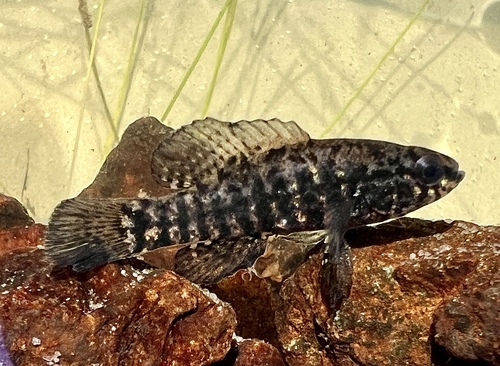
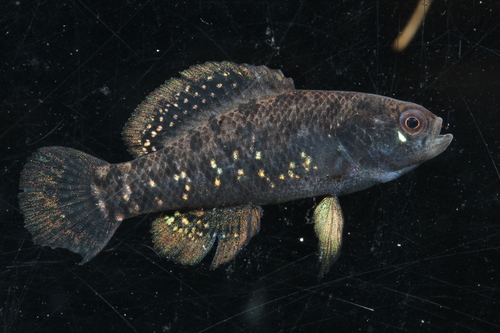
This species, commonly called the Everglades pygmy sunfish, reaches a maximum total length of 3.4 cm, and typically grows to 2.3 cm in total length. Scales cover the top of its head, and it has a small, oblique mouth. No lateral line is present in this fish. Behind each eye, a crescent-shaped area may appear gold or iridescent blue, and it has dark lips. Among captive females, egg counts in the ovaries range from 115 to 500, with the number of eggs increasing as the fish grows larger. This species has variable coloration and body form. Its body is generally brown with darker spots, and it has several rows of dark red spots on its dorsal and anal fins. Nonbreeding individuals may have light streaks, mottling, or blotches. Most females have brown backs with mottled brown and cream or white underparts, though some may be reddish brown, and females have no distinct markings. Breeding males are black with iridescent blue spots. Males have black fins that may or may not have brown spots. Male bodies can be black, brown, or dark green with blotches or spots, and a few indistinct dark bars may appear on the male body. Scattered brassy or blue-green iridescent scales can also be found across male bodies. One source notes that males are dark black with iridescent blue flecks, while females are solid brown. This fish is found in the United States, ranging from the lower Cape Fear River in North Carolina to Mobile Bay in Alabama. It also occurs from southern Florida north to the northern end of the Everglades. In central Florida, it is found more frequently in natural marshes than constructed marshes. It inhabits freshwater demersal habitats with a pH range of 7.0 to 7.5 and a temperature range of 10 to 30 degrees Celsius. It lives in swamps, sphagnum bogs, heavily vegetated sloughs, canals, overflow pools, ponds, lakes, and streams, usually over substrates of mud, silt, sand, limestone, or detritus. It occupies areas with slow current and fluctuating water levels, and prefers shallow, vegetated areas. Compared to other species in its genus Elassoma, this species is more restricted to black water environments. Its population density depends heavily on local environmental conditions, but it is considered common across most of its range. As of 2013, its total overall population was estimated at 100,000 individuals, and the population is large and stable.