About Elaphodus cephalophus Milne-Edwards, 1872
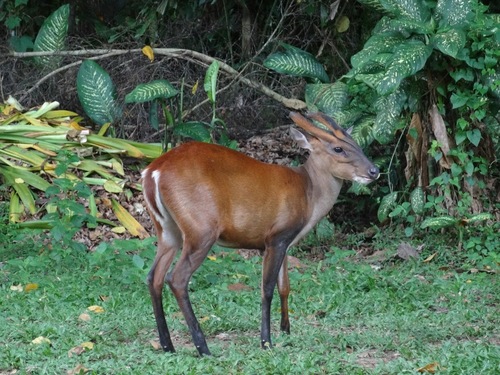
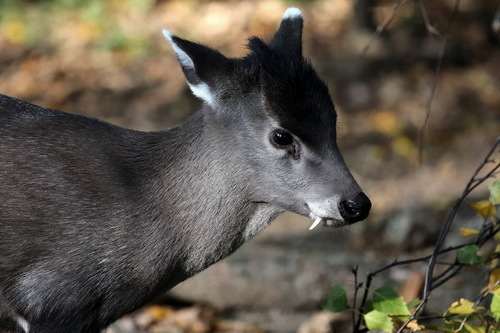
The tufted deer (Elaphodus cephalophus Milne-Edwards, 1872) resembles muntjacs in appearance, but has longer necks and legs that give it a slightly leaner build. Its coat is coarse, made of short, stiff hairs; it is almost black in winter and chocolate brown in summer. The lips, ear tips, and underside of the tail are white. A brown to black, horseshoe-shaped tuft of hair grows on the forehead and upper neck, and can reach up to 17 centimeters (6.7 inches) long. The most notable feature of this species is the fang-like canines found in males. These canines can grow up to 2.6 cm (1.0 in) long, and can be even longer in rare cases. Tufted deer are small deer, though they are larger than most muntjac species. They stand 50–70 centimeters (20–28 in) tall at the shoulder, weigh between 17 and 30 kilograms (37 to 66 lb), and have a short tail that measures around 10 cm (3.9 in). Only males have antlers, which are extremely short and almost entirely hidden by the species' long forehead tuft. Tufted deer occur mainly in China, ranging across the country's south from the eastern coast to eastern Tibet, and are absent from China's extreme south. There are old historical records of the species in northeastern Myanmar, but recent surveys have not found any individuals there, possibly due to insufficient surveying of its preferred habitat. Its distribution overlaps with that of other species, including the Sambar. This deer inhabits high, damp forests between 500–4,500 metres (1,600–14,800 ft) above sea level, close to the tree line. It lives in both evergreen and deciduous forests that have extensive understory and a nearby freshwater source, including Gongga Mountain National Nature Reserve. On Gongga Mountain, plant communities shift with increasing altitude: lower mountain areas host mostly subtropical vegetation, while higher elevations support plants adapted to cold, harsh conditions including snow. Tufted deer's preference for montane forests highlights their ability to live in regions with variable temperatures. The presence of salt licks is also a positive factor that supports the presence of tufted deer. This species can tolerate minor human disturbance, and is occasionally found in cultivated lands. Tufted deer are mainly solitary or live in pairs. They are crepuscular, and travel along fixed routes through their territories, which males defend vigorously. They are timid animals that prefer areas with dense cover, where they are well camouflaged. They are easily disturbed; when alarmed, they bark before fleeing, moving in quick cat-like jumps. The mating season runs between September and December, when the loud barking made by males can be easily heard. Gestation lasts around six months, and females give birth to litters of 1–2 young in late spring and early summer. Young tufted deer reach sexual maturity at 1–2 years of age, and can live 10–12 years in the wild. The tufted deer has a polygynous mating system, which leads to males fighting over access to mates. Adult males also fight over territory to establish dominance. When fighting, males use their elongated canines as their main weapon; they also use their antlers, though these are not as dangerous.