About Elaphe sauromates (Pallas, 1811)
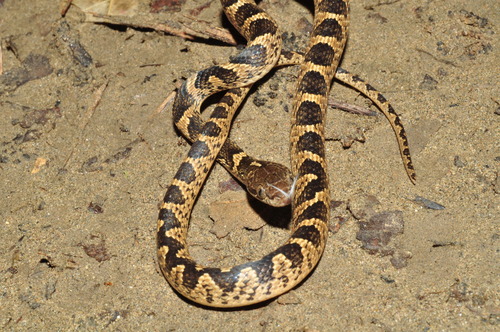
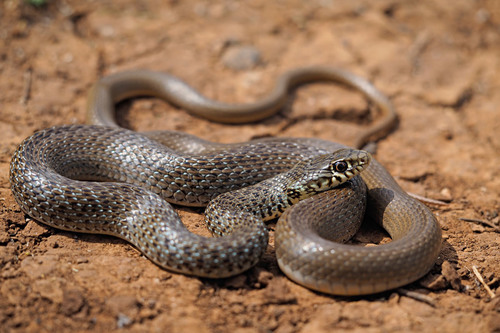
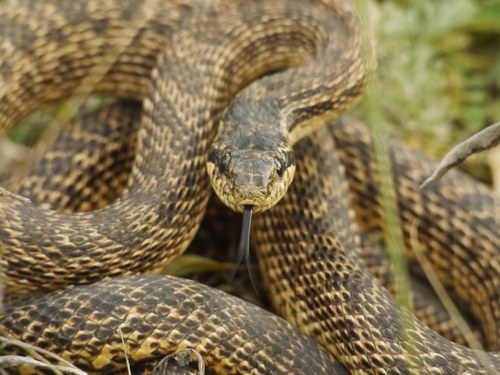
This species is commonly known as the blotched snake, with the scientific name Elaphe sauromates (Pallas, 1811). It is a large snake that reaches a maximum total body length of up to 2 meters. However, in 1930, Constantin Kirițescu reported a 2.60-meter specimen that was captured by Dombrovsky in 1901 at Cernavodă, which he personally studied. Some researchers believe this report draws inspiration from local legends about giant snakes. The ratio of combined head and trunk length to tail length is 3.9 in males and 5.1 in females. The body width ranges from 5 to 6 cm. Its head is only weakly separated from its neck. It has medium-sized eyes with round pupils, and maxillary teeth that are all equal in length. The blotched snake typically has 25 dorsal scales, rarely 23 or 27, and its lateral scales are smooth. Males have 187 to 224 ventral scales, while females have 205 to 234 ventral scales. Individuals of this species have between 56 and 90 subcaudals, and the anal plate is divided in most cases. Each scale has a dark brown spot on a yellowish-white or pinkish-white base background, and dark brown pigment is the most dominant. Dorsal coloration varies: adults are usually tan or reddish-brown on the back, while juveniles are gray or yellowish-brown. The back has large, irregular dark spots that are rhombic or oval and slightly elongated transversely. These spots are arranged in 4 longitudinal rows, with 4 to 5 rows in juveniles. On the ventral side, there is a row of smaller dark spots that match the back's color, and these spots often form a continuous dark stripe. Some scales on the sides of the body are reddish or orange. This color pattern is most distinct in young specimens. The upper head and nape of adult blotched snakes are uniformly dark brown or grey-brown. The blotched snake's geographic range includes southeastern Europe (Albania, southeastern Romania, Republic of Moldova, southeastern Bulgaria, northeastern Greece, southern Ukraine, European Turkey), western Levant (Syria, Lebanon, Israel), southwestern Russia (Dagestan), the Caucasus (Georgia, Armenia, Azerbaijan), southwestern Kazakhstan, northwestern Turkmenistan, and western Iran. It inhabits steppes, semi-deserts, premontane and montane meadows, rocky slopes covered with shrubs, and riparian forests. It can live at elevations up to 2500 meters above sea level in the Caucasus. It is frequently seen near human houses, in vineyards, and in orchards. It shelters in tunnels dug by gophers, gerbils, and other small rodents, as well as in soil cracks and tree hollows.