About Elanus leucurus (Vieillot, 1818)
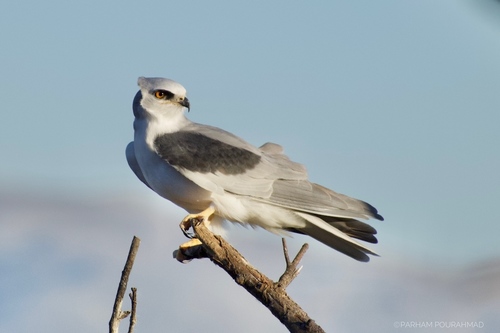
The white-tailed kite (Elanus leucurus) has gull-like coloration, but falcon-like shape and flight, and a rounded tail. It has white faces and white underparts, with black wingtips, beaks, and shoulders. In contrast, its deep red eyes stand out especially at night. This is a mid-sized kite species: it measures 35–43 cm (14–17 in) in total length, has a wingspan of 88–102 cm (35–40 in), and weighs 250–380 g (8.8–13.4 oz). Both its wings and tail are relatively elongated, and its tarsus measures around 3.6 cm (1.4 in).
In the 1930s and 1940s, white-tailed kites were driven almost to extinction in California due to shooting and egg-collecting, but the species has since recovered and is now common again in the state. Their distribution in California is patchy: they can be found in the Central Valley, southern coastal areas, open land around Goleta including the Ellwood Mesa Open Space, marshes in Humboldt County, and around the San Francisco Bay, but remain rare or absent elsewhere in California. White-tailed kites are non-migratory. Their range extends from southern Texas and eastern Mexico to the Baja California Peninsula, and through Central and South America to central Argentina and Chile. The IUCN does not consider this species to be threatened globally. Rarely, individual white-tailed kites can be sighted far outside their usual range; as of 2010, two individuals had been recorded in New England at different times.
White-tailed kites typically build their nests at the tops of trees, usually 20 to 50 feet above ground level. Nests may be placed in isolated open-country trees, at the edge of a forest, or inside a forest. They construct nests from medium-sized sticks and twigs, grasses, weeds, hay, and moss. A typical nest measures about 21 inches across, with an inner cup that is roughly 7 inches across and 4 inches deep.