About Elanus axillaris (Latham, 1802)
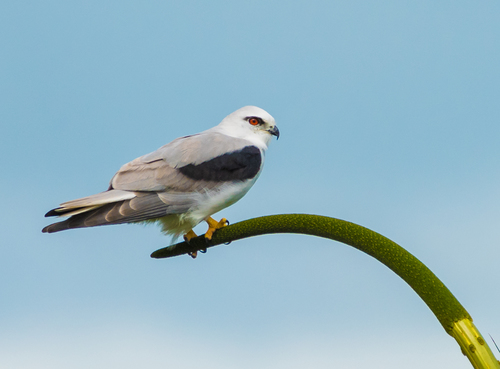
Description: The adult black-shouldered kite (Elanus axillaris) reaches around 35 cm (14 in) in length, with a wingspan between 80 and 100 cm (31 and 39 in). Females are slightly heavier, averaging around 300 g (11 oz), while males average 260 g (9.2 oz). The sexes have identical plumage: the crown, neck, and upperparts are pale grey, and the head and underparts are white. A black comma-shaped marking sits in front of, then stretches over and behind the deep red eye, which is surrounded by a black orbital ring. The leading edge of the outer wing is black; when perched, this creates the species' prominent black 'shoulders'. The central tail feathers (central rectrices) are pale grey, and all other tail feathers are white. The bill is short, with a sharp hooked tip on the upper mandible. The nostrils and cere are bright or dull yellow, and the bill itself is black. The legs and feet are yellow or golden-yellow, with three toes facing forward and one facing backward. Juvenile black-shouldered kites have a white forehead and chin, a rusty brown neck, nape, and breast with darker streaks, and mottled buff or brown back and wings. They have a less distinctive dark shoulder patch, a larger comma-shaped patch over the eyes, dark brown eyes, and a black bill with a horn-coloured cere. Black-shouldered kites spiral into the wind like a kestrel. They soar with wings held in an upward-curved V-shape, with primaries slightly spread and the tail widely fanned. This gives the tail a squarer appearance and makes visible 'fingers' on the wings. Level flight follows a rather indirect path. Their flight pattern is described as 'winnowing', with soft steady wing beats interspersed with long glides on angled wings. They are most often seen hovering with curved wings and the tail pointed downward. The black-shouldered kite is very similar to the closely related letter-winged kite (E. scriptus), but can be distinguished by its black mark above and behind the eye, a white rather than grey crown, and all-white underparts in flight (other than the black shoulder markings, dark wingtips, and a small black underwing patch). It is slightly larger than the nankeen kestrel (Falco cenchroides). The nankeen kestrel has pale brown plumage, lacks black wing markings, holds its wings level when soaring, and has a faster wingbeat when hovering. The grey falcon (Falco hypoleucos) has somewhat similar coloration to the black-shouldered kite, but is bulkier and heavier overall, lacks the black markings, has barred wings, and preys on birds. The grey goshawk (Accipiter novaehollandiae) has wider, more rounded wings, underwing markings, and glides with lowered wings. Distribution and habitat: Black-shouldered kites may be sedentary or nomadic, and are generally found in open grasslands or valleys with scattered clumps of trees, where grass or groundcover grows 30 cm to 1.5 m (1–5 ft) high and is accessible from the air. In addition to native grasslands, they forage over pastures, cereal or vegetable crops, and vineyards, and often focus on areas that have been recently harvested or ploughed, which leaves prey more exposed. In urban areas, they are found on the edges of towns, in wasteland, irregularly mown areas, sports fields, golf courses, and grassy roadside verges. They also hunt over coastal dunes and drier marshland, but avoid areas with dense cover such as forest, as well as bare or rocky ground. Their population numbers fluctuate with drought and floods, and they can be irruptive in response to sudden increases in mouse populations. The most distant bird banding recovery was a movement from the Red Banks area in South Australia to Lithgow in eastern New South Wales over three and a half years, a distance of 1,073 km (667 mi). While they have been reported across all of Australia, they are most common in the relatively fertile south-east and south-west corners of the mainland, and in south-east Queensland. They are rare in the deep desert and drier areas such as western Cape York or the Northern Territory, and are occasional visitors to northern Tasmania, King Island, and the Torres Strait islands. Food and hunting: The black-shouldered kite is a specialist predator of the introduced house mouse, and often follows mouse plague outbreaks in rural areas. It takes other appropriately sized prey when available, including grasshoppers, rats, small reptiles, birds, and even (very rarely) rabbits, but mice and other mouse-sized mammals make up over 90% of its diet. The species' impact on mouse populations is likely significant; each adult can eat two or three mice a day if possible, which adds up to around one thousand mice per year. On one occasion, a male was observed bringing no fewer than 14 mice to a nest of well-developed fledglings within one hour. In another study, a female kite was seen carrying a three-quarters grown rabbit back to nestlings, a very heavy load for such a small bird. Like other elanid kites, the black-shouldered kite hunts by systematically searching grasslands for small prey. Hunting may be done from a perch, but more often it is done by hovering in mid-air. It is diurnal, and prefers to hunt during the day, especially early morning and mid to late afternoon, and occasionally hunts in pairs. Outside of breeding seasons and periods of abundant prey, its hunting activity has distinct crepuscular peaks, which likely aligns with mouse activity. When hunting, the kite hovers with its body held almost vertically and its head pointed into the wind. Unlike the nankeen kestrel, the black-shouldered kite shows no obvious sideways movement, even in a strong breeze. One study of a nesting pair found the male searched aerially for 82% of his total search time. Typically, a kite hovers 10 to 12 m (35 to 40 ft) above a specific spot, staring intently downward, sometimes for just a few seconds and often for a minute or more, before gliding quickly to a new spot and hovering again. When hunting from a perch, a dead tree is the preferred platform. Like other Elanus kites, the black-shouldered kite grips a vertical branch with one foot on either side, each foot placed above the other and turned inward, which lets it stay securely on relatively small branches. Though hovering is the most common hunting method, kites have been observed watching the ground from a vantage point for up to an hour at a time. When a mouse or other prey is spotted, the kite drops silently toward it feet-first, with wings held high. The drop may be a single long plunge all the way to the ground, but more often happens in two or more stages, with hovering pauses at intermediate heights. Prey is seized in the talons, and around 75% of all attacks are successful. Prey may be eaten in flight or carried back to a perch. Individual birds will use a favoured feeding perch, and piles of pellets (castings) accumulate beneath it.