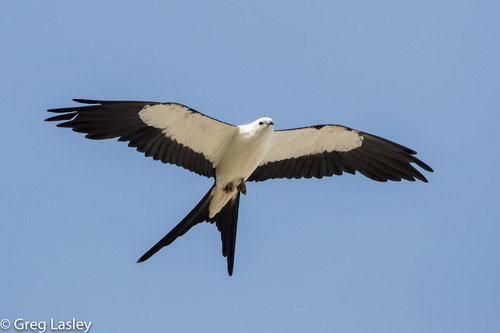
About Elanoides forficatus (Linnaeus, 1758)
Elanoides forficatus, the swallow-tailed kite, measures 50 to 68 cm (20 to 27 in) in body length, with a wingspan of approximately 1.12–1.36 m (3.7–4.5 ft). Body weight ranges from 310–600 g (11–21 oz), and male and female individuals appear similar in appearance. The bird’s body has a contrasting pattern of deep black and white. Flight feathers, tail, feet, and bill are all black; the upper side of the wings matches this black coloration, while the underside of the wings is partly black and partly white. A defining characteristic is its elongated, forked tail, which is 27.5–37 cm (10.8–14.6 in) long, giving the species its common swallow-tailed name. The wings are also relatively elongated, with a wing chord measurement of 39–45 cm (15–18 in). For the bird’s overall size, the tarsus is fairly short at 3.3 cm (1.3 in). Young swallow-tailed kites are duller in color than adults, and their tails are not as deeply forked. The species occasionally emits a high-pitched chirp, but mostly remains silent. This raptor is largely associated with large tracts of wetland forests that suit its nesting habits. Loblolly pines (Pinus taeda) are the most common tree chosen for nest building, but bald cypress (Taxodium distichum) are also used when pines are not available. The key requirements for nesting sites are food availability and sufficient tree height; nests are most often located in trees as high as 100 ft (30 m). Historically, the species’ range in the United States covered most Southern states and much of the Midwest, including Kentucky, Indiana, Ohio, Illinois, Missouri, Iowa, Kansas, Nebraska, and extending as far north as Wisconsin and Minnesota. Outside of the U.S., it lives in many areas across Central and South America. Habitat degradation and changes to wetland hydrology have caused the U.S. range to shrink to only coastal regions of the southeastern and southwestern U.S., corresponding to roughly an 80% decline in the total population. Swallow-tailed kites are migratory raptors; during spring, they typically move from their ranges in Central and South America to breeding grounds. Around 3% of the world’s population of the species breeds in the United States. The birds travel thousands of miles to reach the most suitable nesting habitat in coastal wetlands between the Americas. Satellite telemetry has allowed researchers to track individual bird movements over multiple years, and collected data shows some migration journeys are longer than 10,000 mi (16,000 km). Land along migration routes is considered another conservation concern for the species: deforestation and habitat degradation in Central and South America can have negative impacts as the birds travel to breed. Swallow-tailed kites are considered one of the most graceful fliers found in the Americas. They spend most of their lives scanning high treetops for lizards, small mammals, and insects. The structure of the species’ wings and tail allows it to glide effortlessly over long distances. Mating occurs from March to May. Females lay two to four white or bluish white eggs that are spotted with brown. Incubation lasts 28 days, and chicks take 36 to 42 days to fledge. While often reported to form monogamous pairs, the birds generally spend part of the year apart and meet up during migration to nesting locations. Nesting sites are typically located in the tallest trees in wetland areas. Occasionally, pairs return to the same nesting location they used the previous year and refurbish an old nest. New nests generally take about four days to complete.