About Elaeodendron australe Vent.
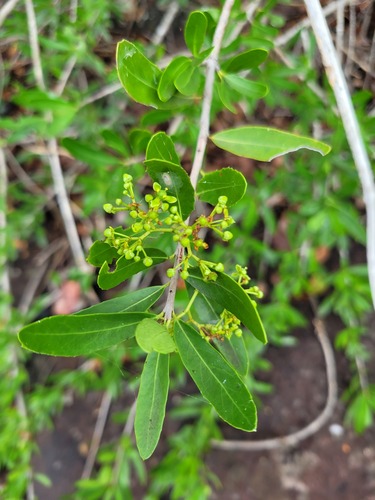
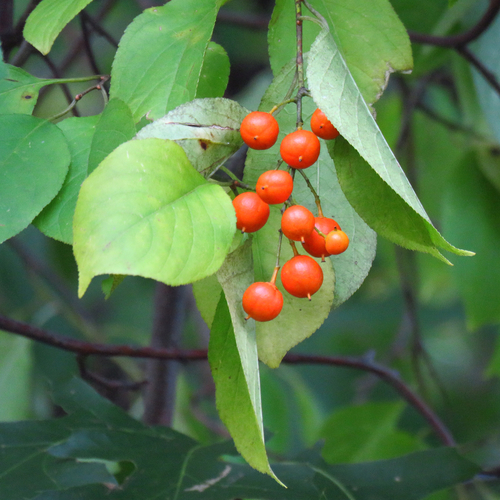
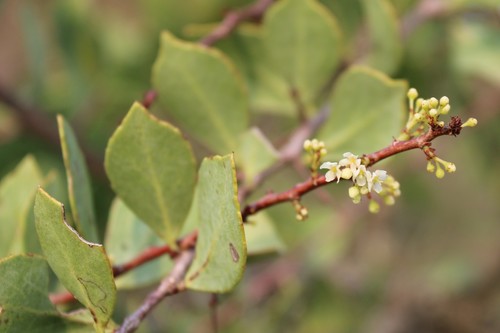
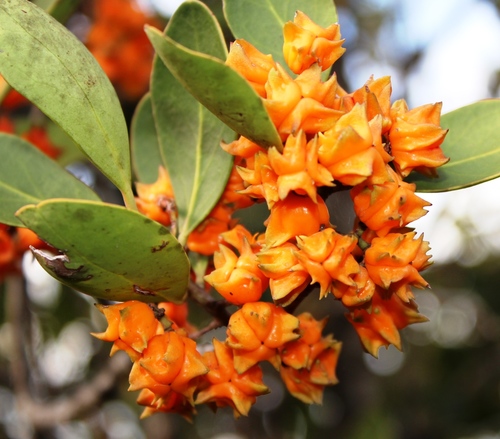
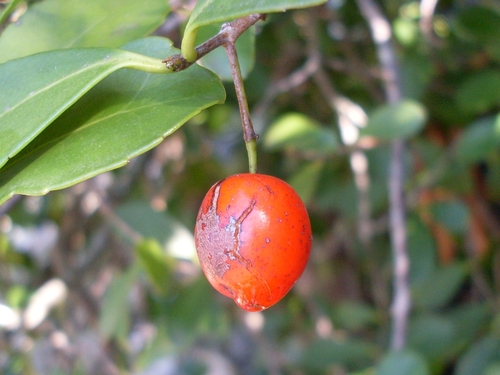
Elaeodendron australe Vent. is a species of shrub or small tree that usually reaches a maximum height of 8 meters, or 26 feet. This species is dioecious, meaning it has separate male and female individual plants that bear different types of flowers. Its leaves are most commonly arranged in opposite pairs. They range in shape from egg-shaped to elliptic or oblong, with wavy edges. Leaves measure 27 to 150 millimeters (1.1 to 5.9 inches) in length and 4 to 70 millimeters (0.16 to 2.76 inches) in width, and grow from a petiole 4 to 10 millimeters (0.16 to 0.39 inches) long. Flowers are arranged in cymes located in leaf axils, growing from a peduncle that reaches up to 12 millimeters (0.47 inches) long. Each individual flower sits on a pedicel 3 to 7 millimeters (0.12 to 0.28 inches) long. This species has four yellowish-green petals that are around 4 millimeters (0.16 inches) long. Male flowers produce four stamens, while female flowers produce four staminodes. Flowering takes place during spring and summer. The fruit is a fleshy drupe that ranges from oblong to oval in shape, and is orange-red in color. It measures 10 to 25 millimeters (0.39 to 0.98 inches) long. Fruits ripen between March and July, and often stay attached to the plant for many months after ripening. Common called red olive-berry, this plant grows in ecotone areas between eucalypt forest and rainforest, as well as in littoral rainforest and dry rainforest. It occurs in north-eastern and central eastern Queensland, and extends south as far as Tuross Head in New South Wales. An unusual thick-leaved form of the species grows in Mount Kaputar National Park, as well as on nearby western slopes and in gorges of dry tablelands. In horticulture, propagation by seed is very slow, but germination is reliable, with around a 25% success rate after twelve months.