About Elaeocarpus reticulatus Sm.
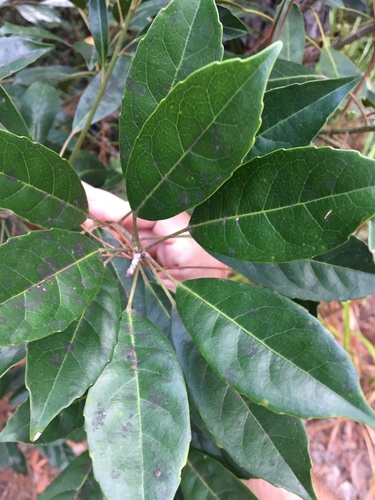
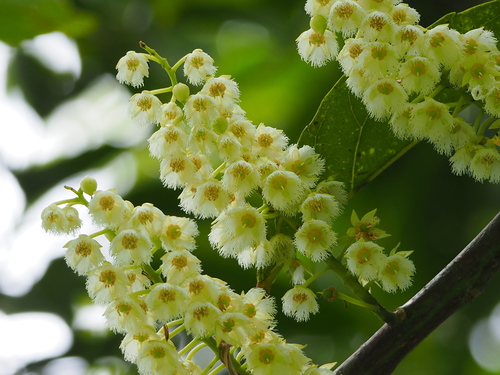
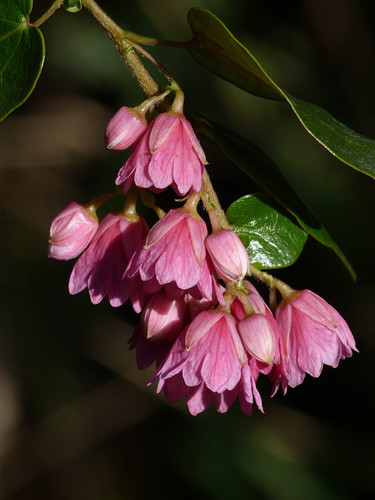
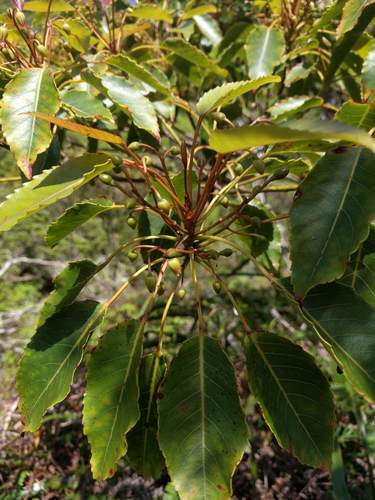
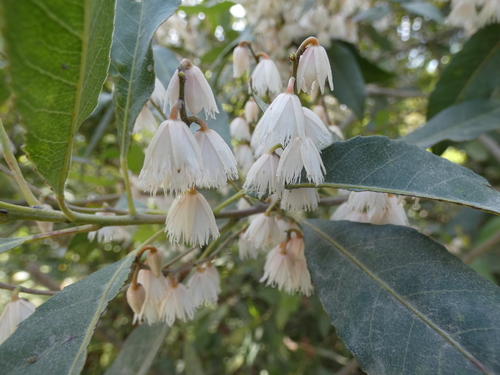
Elaeocarpus reticulatus Sm., commonly known as blueberry ash, is a shrub or small tree that typically reaches 3–10 metres (9.8–32.8 feet) in height, though it can grow as tall as 30 metres (98 feet) in some conditions, and it has a lignotuber at its base. Its leaves are simple, technically a compound leaf with a single leaflet, shaped oblong to elliptic. Most leaves are 50–130 millimetres (2.0–5.1 inches) long, 10–40 millimetres (0.39–1.57 inches) wide, and grow on a petiole that is 5–20 millimetres (0.20–0.79 inches) long. The leaves are more or less hairless, often turn red before they fall, have regularly spaced teeth along their edges, bear small domatia, and have a prominent network of veins on both upper and lower surfaces. Flowers are arranged in racemes that grow 50–80 millimetres (2.0–3.1 inches) long, with five to ten flowers per raceme. Each individual flower sits on a pedicel 4–8 millimetres (0.16–0.31 inches) long. The five sepals are narrow triangular, measuring 5–6 millimetres (0.20–0.24 inches) long and about 1 millimetre (0.039 inches) wide. The five petals are white, sometimes with a pinkish tint, 6–7 millimetres (0.24–0.28 inches) long and about 2 millimetres (0.079 inches) wide, with seven to ten linear lobes at the petal tip. Each flower has between thirteen and fifteen stamens, and a style 3–4 millimetres (0.12–0.16 inches) long. Flowering occurs from October to January, and the fruit is a blue drupe that is more or less spherical, oval, or elliptical, around 12 millimetres (0.47 inches) long. Blueberry ash most often grows in tall eucalypt forest, in or adjacent to rainforest, and commonly occurs in moist gullies, though it can also be found on stony ridges. It grows along the east coast of Australia, ranging from Fraser Island in Queensland to Flinders Island in Tasmania. In New South Wales, it occurs from sea level up to the tableland ranges, and in Victoria it is found east of Wilsons Promontory, where it is often locally common. The fruits of Elaeocarpus reticulatus are eaten by birds, including wonga pigeons, crimson rosellas, figbirds, white-headed pigeons, and olive-backed orioles. Regent bowerbirds collect these fruits to decorate their bowers. In horticulture, blueberry ash is described as an outstanding specimen tree for coastal gardens. It can be propagated from semi-hardwood cuttings taken during warmer weather, while germination from seed can take several years. This plant is hardy in most growing conditions and can be grown in locations ranging from full shade to full sun.