About Elaeocarpus obovatus G.Don
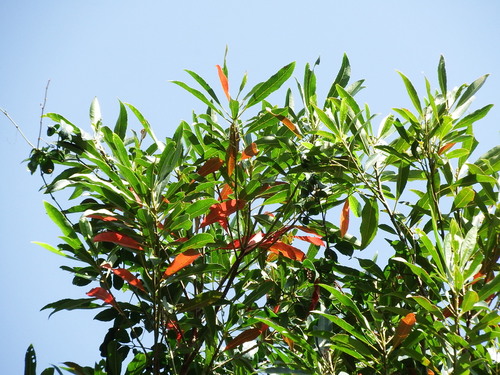
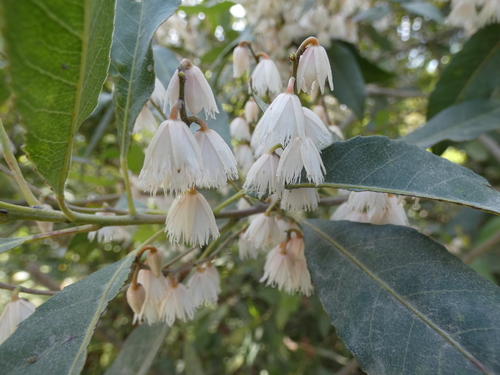
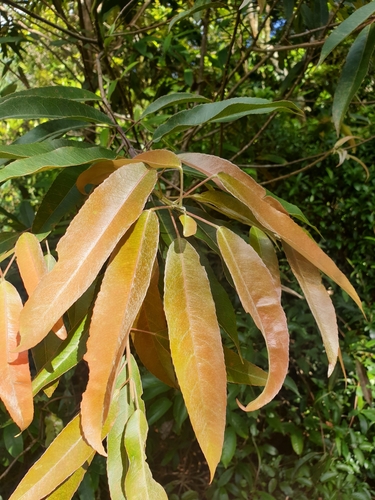
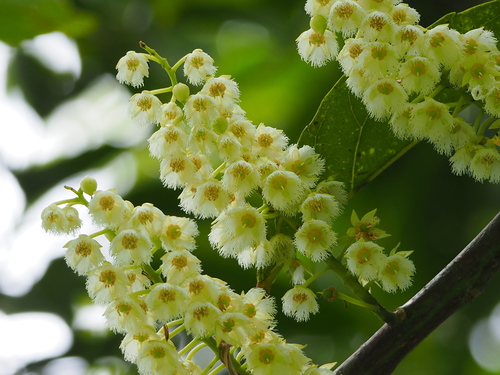
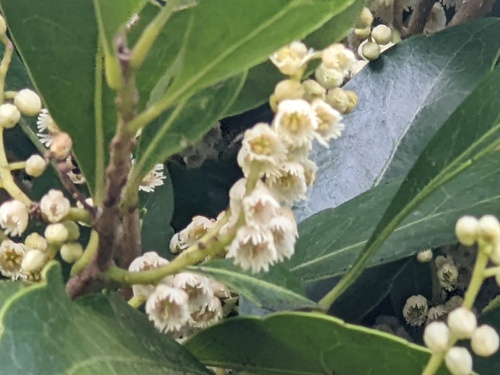
Elaeocarpus obovatus, also commonly called hard quandong, sometimes grows as a small tree between 3 and 10 meters (9.8 to 32.8 feet) tall. It may also grow as a tall tree reaching up to 45 meters (148 feet) in height, with buttress roots at the base of a trunk that can grow up to 150 centimeters (59 inches) in diameter. Its outer bark is smooth, thin, and grey, with irregular corky patches. Leaves are arranged alternately, and are shaped egg-shaped to lance-shaped with the narrower end at the base. Each leaf is 40 to 85 millimeters (1.6 to 3.3 inches) long, 14 to 22 millimeters (0.55 to 0.87 inches) wide, and grows on a 2 to 6 millimeter (0.079 to 0.236 inch) long petiole. Leaf edges are wavy, scalloped, or toothed, and the midrib is raised on both the upper and lower surfaces of the leaf. Flowers are arranged in racemes 40 to 80 millimeters (1.6 to 3.1 inches) long, each holding 10 to 20 individual flowers. Each flower grows on a 4 to 5 millimeter (0.16 to 0.20 inch) long pedicel, and has four or five egg-shaped to triangular sepals that are 2 to 3 millimeters (0.079 to 0.118 inches) long and 1 to 1.5 millimeters (0.039 to 0.059 inches) wide. Petals are white, egg-shaped to oblong, and roughly the same size as the sepals. The tip of each petal is divided into eight to ten lobes, and the flower has around twenty very short stamens. Flowering occurs from late August to October. The fruit is an oval to elliptical blue drupe around 10 millimeters (0.39 inches) long and 8 millimeters (0.31 inches) wide, containing a single seed. Fruiting occurs from January to April. This species grows as a tall tree in subtropical rainforest, and as a small to medium-sized tree in drier rainforest. It occurs between Proserpine, Queensland (20° S) in central-eastern Queensland, south to Wyong (33° S) in New South Wales.