About Elaeocarpus kirtonii F.Muell. ex F.M.Bailey
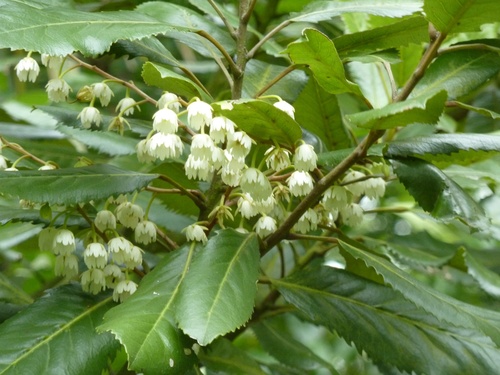
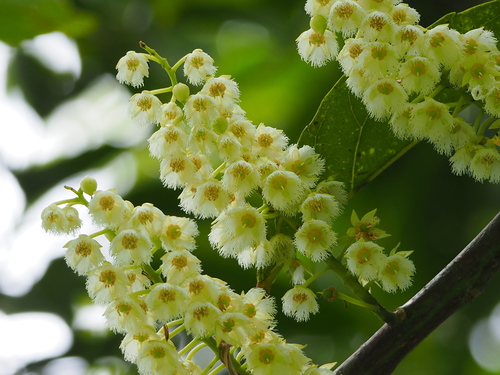
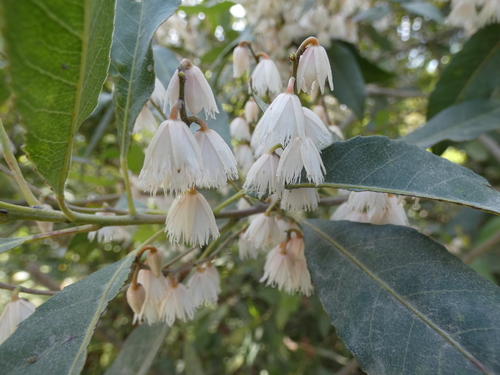
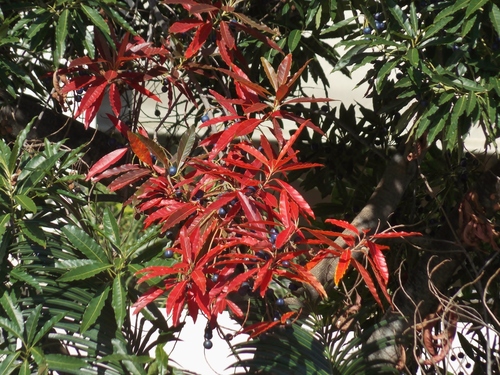
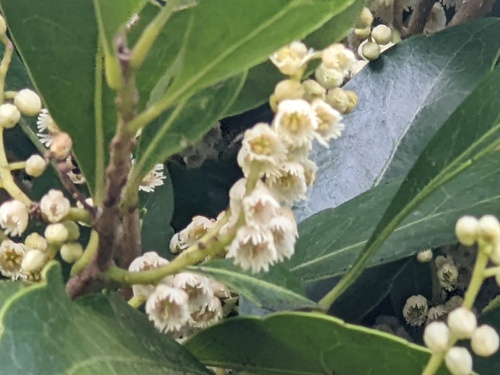
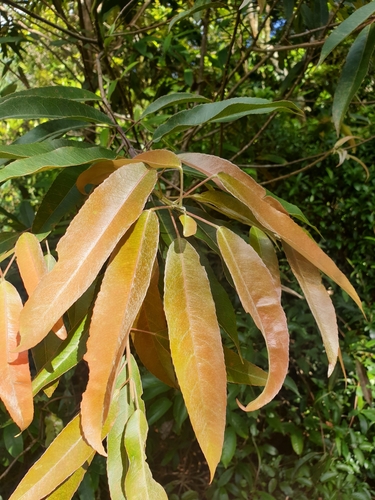
Elaeocarpus kirtonii F.Muell. ex F.M.Bailey is a large, often dominant tree that typically reaches 30 m (98 ft) in height and about 1 m (3 ft 3 in) in diameter, though it may occasionally grow to 45 m (148 ft) in height and 2 m (6 ft 7 in) in diameter. This species produces buttress roots that grow up to 3 m (9.8 ft) high. Its outer bark is thin, silvery grey, and marked with small pustules. New growth is salmon-pink in color. Leaves are clustered near the ends of branchlets, with a shape ranging from narrow elliptic to narrow oblong. Mature leaves measure 70–200 mm (2.8–7.9 in) long and 20–40 mm (0.79–1.57 in) wide, attached to branchlets by a 15–50 mm (0.59–1.97 in) long petiole. The leaves are dull green with prominent veins, have regularly spaced teeth along their edges, and turn red before falling. Flowers are arranged in racemes that are mostly 60–100 mm (2.4–3.9 in) long, with 15 to 20 sweet-scented flowers per raceme. Each individual flower sits on a pedicel 6–10 mm (0.24–0.39 in) long. This species has five sepals, which are very narrow ovate to triangular, measuring 5.5–6 mm (0.22–0.24 in) long and 1.5 mm (0.059 in) wide. It also has five white petals, 7.5–10 mm (0.30–0.39 in) long and 2.5–3 mm (0.098–0.118 in) wide, with around 24 linear lobes at the petal tip. Each flower has between 25 and 30 stamens. Flowering occurs from January to March. The fruit is a pale blue, oval drupe 10–13 mm (0.39–0.51 in) long, which matures between October and January and encloses a hard, sculptured stone. Commonly called silver quandong, Elaeocarpus kirtonii is distributed from near Milton (35° S) in New South Wales north to Eungella National Park (20° S) in tropical Queensland. It grows in tropical, subtropical, and warm temperate rainforests, and is also often found in cooler, moister sites on volcanic soils and richer alluvial soils. The fruit of Elaeocarpus kirtonii is eaten by a wide variety of rainforest birds.