About Elaeocarpus eumundi F.M.Bailey
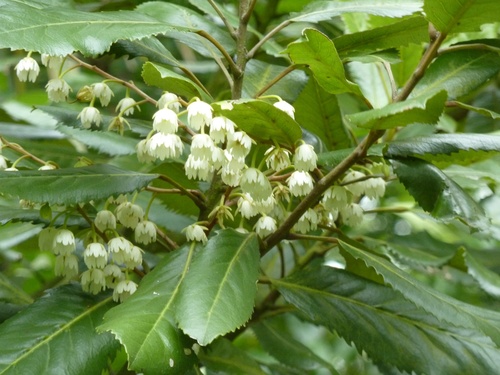
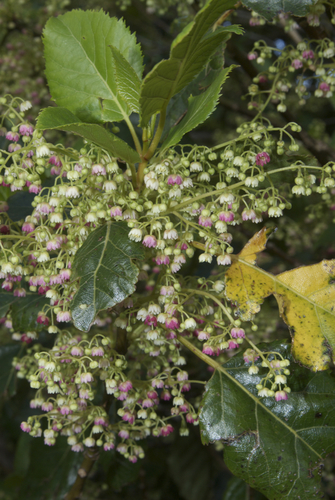
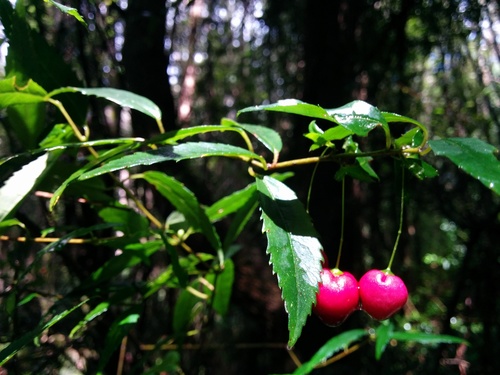
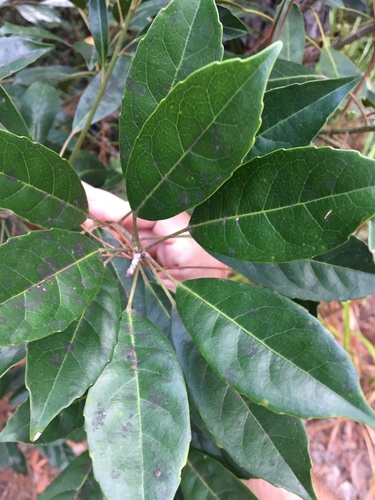
Elaeocarpus eumundi F.M.Bailey is a tree that usually grows between 12 and 25 meters (39 to 82 feet) tall. It has fibrous bark, and sometimes develops buttress roots at the base of its trunk. Most of its leaves are clustered near the ends of branchlets, and are elliptic, egg-shaped, or lance-shaped with the narrower end at the base. The leaves measure 60 to 130 mm (2.4 to 5.1 in) long and 20 to 40 mm (0.79 to 1.57 in) wide, growing on a petiole that is 10 to 50 mm (0.39 to 1.97 in) long. Leaf edges sometimes have small teeth, which are mostly found near the leaf tip. The midvein is prominent on the upper leaf surface, and aging leaves turn yellow instead of red. Flowers grow in groups of up to eight, each borne on a hairy pedicel 6 to 8 mm (0.24 to 0.31 in) long. This species produces five narrow triangular sepals, which are 9 to 9.5 mm (0.35 to 0.37 in) long and about 2 mm (0.079 in) wide. The five petals are cream-colored, up to 11 mm (0.43 in) long and 4 mm (0.16 in) wide. The tip of each petal is split into between 17 and 20 lobes that are 1 to 1.5 mm (0.039 to 0.059 in) long, and each flower has 24 to 30 stamens. Flowering takes place from November to December. The fruit is a blue, oval drupe that is around 15 mm (0.59 in) long. This quandong is widely distributed in rainforest across Cape York Peninsula, northeastern Queensland, and central-eastern Queensland. It grows on a range of site types at altitudes up to 1,000 m (3,300 ft). It is rare in New South Wales, where it only occurs north from the Whian Whian State Conservation Area. Eumundi quandong works well as an ornamental tree in horticulture, and it attracts both nectar-feeding and seed-eating birds. The fruit of this species is reported to be juicy with a sharp acidic flavor.