About Elaeocarpus dentatus (J.R.Forst. & G.Forst.) Vahl
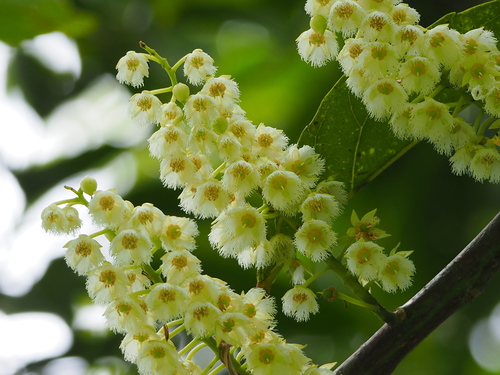
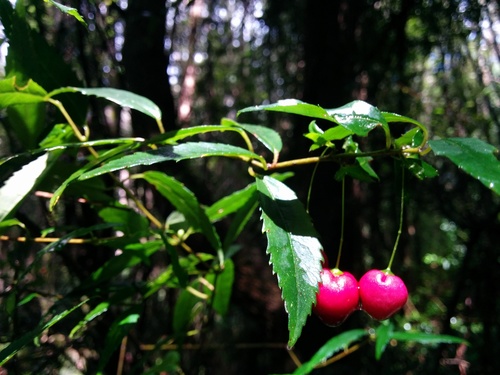
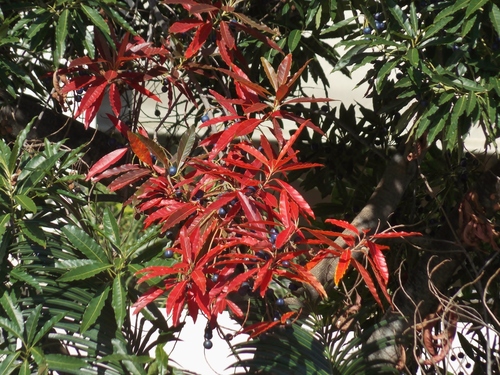
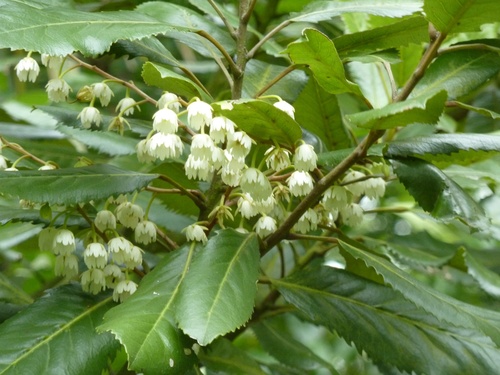
Elaeocarpus dentatus (J.R.Forst. & G.Forst.) Vahl, also called hinau, is a tree that reaches around 18 m (59 ft) in height, with a trunk around 1 m (3.2 ft) in diameter. Its bark is greyish and becomes rougher with age; it has white sapwood and dark brown heartwood. The heavy, strong heartwood is used for fence posts, but it is rarely milled because the trunk is often hollow inside. Its leathery leaves are 10–12 cm (3.9–4.7 in) long and 2–3 cm (0.8–1.2 in) wide, dark green on the upper surface and off-white on the lower surface. It flowers from October to February; the flowers strongly resemble lily of the valley flowers, and grow on 10–18 cm long racemes, each holding 8–10 individual flowers. The drooping white flowers are around 12 mm in diameter, attached to the raceme by 1 cm long silky pedicels. Flowers have 3–5 petals that are lobed at the tip, and long anthers that extend out from short filaments. Sepals are covered in many tiny hairs. This species has 15 pairs of chromosomes (2n = 30) and is bisexual, so each flower contains both male stamens and female carpels. Fruiting begins in December, and fruits ripen in May. The fruits are purple-black, egg-shaped drupes 12–18 mm long and 9 mm wide, which are attractive to birds. This species has 2-celled ovaries and a wrinkly (rugulose) endocarp. The drupes are very fleshy, with flesh making up 56% of their mass, and have a relatively low water content of 66%. Their mean mass is 1.05 g; when moisture is removed, their composition is 69.9% N.F.E (soluble carbohydrates), 21.8% crude fiber, 3.4% crude protein, 3.2% ash, and 1.7% lipid. It is very similar to Elaeocarpus hookerianus, but can be distinguished by its larger leaves, flowers and fruit, and its lack of E. hookerianus's distinctive divaricating juvenile to sub-adult growth form. Elaeocarpus dentatus is endemic to New Zealand, where it grows in both the North and South Islands, ranging south to South Westland on the west coast and Christchurch on the east coast. It grows from sea level up to 600 m (1970 ft), occurring essentially anywhere north of latitude 43°30'S. Ecologically, fallen fruit of this tree is eaten from the ground by North Island brown kiwi (Apteryx mantelli), which use the seeds as grinding agents to help break down food in their gizzards. For kākā on Kapiti Island, the drupes are an important food source, especially in March, and for male kākā they remain an important food source from March through to June. This difference is thought to occur because females have a differently shaped mandible; the fruit hardens in the months after March, so females cannot break into the fruit to access the developing seed, which is the part of the fruit kākā eat. Kākā also rely heavily on hinau and tawa trees to feed their young, due both to the abundance of these trees on Kapiti Island and their heavy fruit crops. Weka (Gallirallus australis) eat fallen fruit from the ground, and are thought to be very important seed dispersers for this tree following the extinction of many of New Zealand's other flightless birds. Hinau seeds may germinate better after their outer coat is torn open, and the weka gizzard might produce this effect, though more research is needed to confirm this. Kōkako eat both the leaves and fruit of E. dentatus, though these make up a very small proportion of the bird's varied and complex diet. The extremely hard endocarp is thought to protect the seed while it passes through the digestive system of large flightless birds, which act as dispersers by eating fallen fruit. It is also possible that the hard endocarp evolved to limit overconsumption of fruit by parrots such as kākā; kākā have been recorded digesting an average of 7.1 seeds per minute in March. Kererū also eat the fruit and act as dispersers, though they are not as important as weka. In New Zealand forests, tree trunks are critical habitat for flightless invertebrates, who use them to reach the canopy for feeding and breeding. One study that trapped invertebrates moving up and down hinau trunks found that the most common species moving upward were springtails, followed by wasps, ants, spiders, beetles, weevils, and mites. When moving downward, mites were the most common, making up 15% of the count, followed by larvae, springtails, and harvestmen. Māori traditionally used the mealy substance covering the kernel of hinau drupes, which is similar to the mealy substance found on olive kernels, to make a type of cake, bread, or alternatively a gruel. Ethnographer Elsdon Best recorded that while the drupes are edible raw, the traditional process to make cake involves drying the fruit for a couple of days, then pounding it in a trough called a kumete using a pestle made of maire wood or stone. This process is called tuki, and is required to remove unwanted nuts, stalks, and fragments of broken skin. The meal is then sifted through baskets made of cabbage tree leaves, which trap the hard stones in the basket (called a tatari or kete puputu). It is then sieved through a finer sieve to ensure no stones (called karihi, iwi, or iho) remain in the meal. After this, the meal is moulded into a large cake, which is cooked for several hours in a steam oven, likely a hāngī, inside wooden baskets called rourou lined with hound's tongue ferns, which also wrap the meal. To recover any meal left on the removed stones, water is used to rub the meal off, and the resulting mixture is drunk as a type of gruel, which Māori call wai haro. Best also recorded that wai haro was usually served heated, by placing hot stones into the liquid. The finished cakes, which weigh 9-13 kg, take 1–2 days of cooking to prepare. William Colenso, writing in 1880, noted that the preparation process differed between iwi: some iwi would steep the fruit in water, while others would pound and sift the fruit without a steeping stage. Another 19th century ethnographer, Richard Taylor, described a similar process, though he recorded that drupes were steeped in running water for a year to remove their bitterness, and cooked wrapped in rangiora leaves. He also described an alternative cooking method where the flour was placed in heated water, and the resulting dish was called rerepi. Later 19th century ethnographer Mākereti Papakura also described soaking the fruit, but did not record a year-long soaking process. While some Europeans did not enjoy the hinau cakes – Elsdon Best wrote that he preferred his own bread and beefsteak – Mākereti Papakura noted that Māori considered hinau meal a great luxury, which is reflected in their saying: "Kia whakaara koe i taku moe, ko te whatu turei a Rua", meaning "When you awaken me from my sleep let it be for the purpose of eating the whatu turei a Rua (Hīnau meal)". Elaeocarpus dentatus fruit is indeed nutritious, and contains fatty acids that may be protective against cardiovascular disease. The bark of E. dentatus produces a brown dye; when dipped in a ferruginous (iron-containing) swamp, the dye becomes a bright, durable black color. This dye had many traditional uses, including as an ink for tā moko and for dyeing harakeke used in weaving. Young seedlings were tied into a knot and left to grow into the shape of a walking stick, then cut and used. Bark was also used to make bags for various purposes, including for preparing raupō pollen bread. Traditionally, the timber of this tree had a range of uses, including for palisades, tools, and spears. Early European settlers used the timber for bridge construction, furniture making, and building houses and boats. In cultivation, Elaeocarpus dentatus prefers rich, moist soil in partial shade. To grow from seed, press the seed firmly into the soil and cover with 5 mm of soil. Germination takes around 6 months, and fresh fruit can be used for propagation.