About Elaeocarpus angustifolius Blume
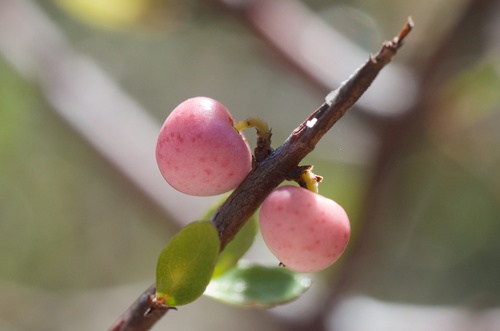
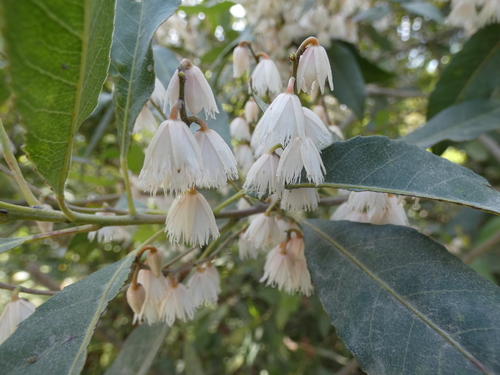
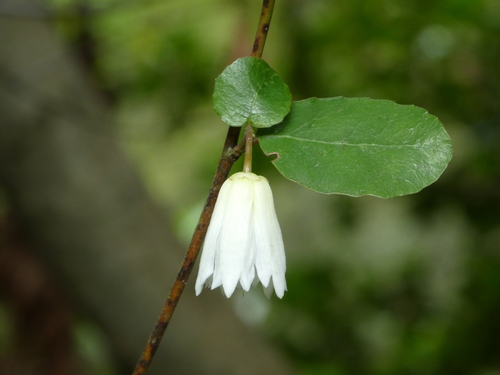
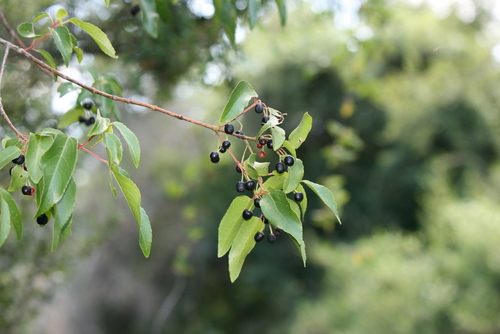
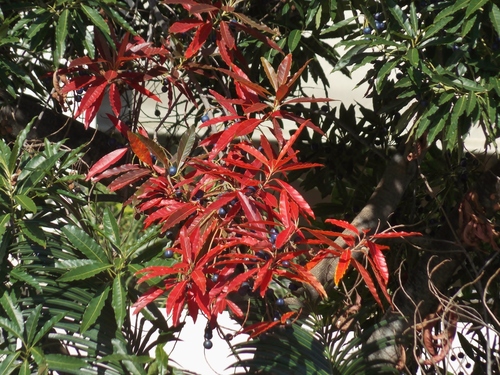
According to M.J.E. Coode, Elaeocarpus angustifolius is a tree that typically grows to a height of 40 m (130 ft), and usually has buttress roots at the base of the trunk. Its leaves measure about 60–180 mm (2.4–7.1 in) long and 40–60 mm (1.6–2.4 in) wide, with wavy serrations on the edges, tapering to a 5–15 mm (0.20–0.59 in) long petiole, and lack a pulvinus. Old leaves often turn bright red before falling. Flowers are arranged in racemes up to 100 mm (3.9 in) long, with each flower growing on a 9–16 mm (0.35–0.63 in) long pedicel. It has five sepals 8–11 mm (0.31–0.43 in) long and 1–2 mm (0.039–0.079 in) wide, and five creamy white, egg-shaped to oblong petals 12–15 mm (0.47–0.59 in) long and 3–4 mm (0.12–0.16 in) wide with linear lobes at the tip. There are between 35 and 60 stamens, and the glabrous style is 11–18 mm (0.43–0.71 in) long. The fruit is a more or less spherical, bright blue or purple drupe 15–23 mm (0.59–0.91 in) in diameter. Coode considered E. grandis to be the same species as E. angustifolius, and the description above applies to both taxa. Mature trees develop massive buttresses that generally completely encircle the trunk base. It has been hypothesized that this may be an adaptation for the species to grow as an emergent in some habitats, or for its common growth in secondary woodland, as buttress roots can better distribute tensile stress at the base of the tree transmitted down from wind in the crown. In E. angustifolius, buttresses are thought to develop in response to stresses the tree experiences during relatively brief periods of fast growth. The wood of buttresses has a different partial composition than the wood of the main trunk. This species has a wide native distribution that extends from the Himalayas in Nepal and India east to China and the Philippines, and south to Indonesia, Papua New Guinea and Australia. E. angustifolius is typical of second-growth forest. Large individuals found in what appears to be primary rainforest are believed to be elderly remnants from a time when the rainforest was less undisturbed, and had been disturbed by fires, storms, or human activity. It is also sometimes found in somewhat swampy areas, or at least along watercourses, and in more cultivated or even urban settings. In New Caledonia, its tendency to grow in disturbed sites has been used in archaeology to study human influence on rainforest species composition, as long-term human presence increases the population of this species. Writing from Ambon Island in the mid 17th century, Rumphius recorded that large birds, especially wreathed hornbills, readily eat the fruits of this species; fruit bats also feed on the fruit. In northern Australia, E. angustifolius (currently called E. grandis by some authorities) is one of a few dozen species of relatively large-fruited rainforest plants eaten by double-wattled cassowaries. It is almost certain that these flightless birds feed on the fruit and likely disperse the seeds regardless of current taxonomic classification; cassowaries have been recorded eating all types of Elaeocarpus fruit, including fruit of this genus on Seram and the Aru Islands, where E. angustifolius occurs. Although seeds dispersed in cassowary dung do germinate, the germination percentage for Elaeocarpus is quite low compared to other rainforest species eaten by cassowaries. A similar pattern is seen for tree-kangaroos (Dendrolagus spp.). A three-year study of dwarf cassowary faeces in Papua New Guinea found that despite producing fruit continuously year-round, E. angustifolius (classified there as E. sphaericus) was only consumed primarily in November, just before a "lean" period with few fruiting plants in the rainforest, with some fruit consumed in January. It was an unimportant part of the dwarf cassowary diet, possibly only eaten when more preferred fruit is not widely available. Flowers of E. angustifolius have been recorded being visited by various beetles, flies and wasps. Hundreds of years ago, this plant was an important product in international trade, specifically the burl-like stones that contain its seeds. According to Rumphius, trade of these stones, known as ganiter or ganitris across Malay, Javanese and Balinese languages, was common practice across the Indonesian archipelago, and these terms were recognized across the East Indies. Not all stones were valuable: the highest quality stones were smaller and coloured deep brown. The stones were often collected from cattle defecation, as passing through the cattle's stomachs gave the stones the preferred colour, though less scrupulous dealers soaked stones in seawater to achieve a similar effect. Stones that had lain on the ground turned a less appealing grey and had no commercial value. A trader could collect 3,000 Dutch pounds of unsorted stones at a port in Java, Madura or Bali for only around 60 silver real. Merchants sorted their cargo, retaining only small and medium stones and discarding the rest. Medium-sized stones were not very valuable, but Hindus and Arab traders would pay a high price for small stones—up to 10 real for a handful—to make religious objects for priests. A hole was bored through each stone, which were strung into chains worn around the body in the same way Europeans use coral in rosaries. Hindu priests were the primary customers, but Muslim imams also used these strung stones as prayer beads to recite the Tasbih. The wealthiest priests would add a golden nugget after every two ganiters, leading Chinese people to call the stones kimkungtsi, meaning "gold hard seeds". Good quality stones were so valuable that counterfeits were carved from hardwood, so experienced traders (Codjas) developed skill to distinguish genuine stones from fakes. In some parts of Java, the local population used a specific cultivation method to ensure a harvest of desirable small stones: when trees just started fruiting and young fruit were beginning to develop, they stripped long strips of bark from the main branches and some from the trunk, which stunts the growing fruit and results in smaller, more grooved stones.