About Elaeagnus angustifolia L.
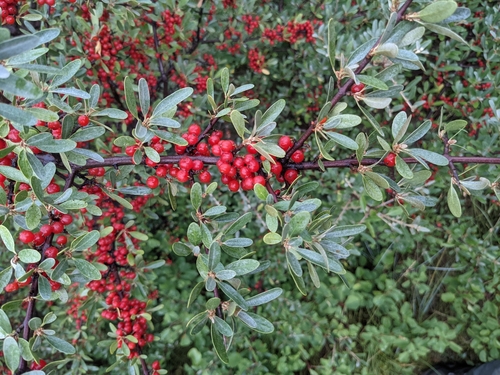
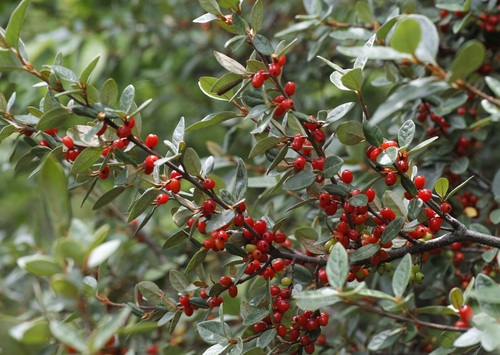
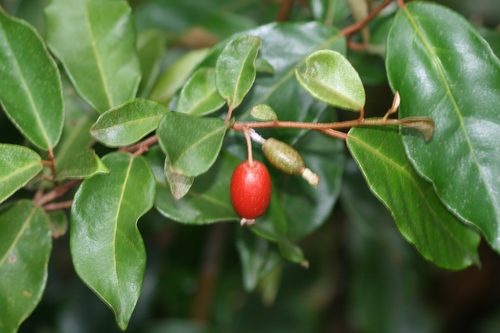
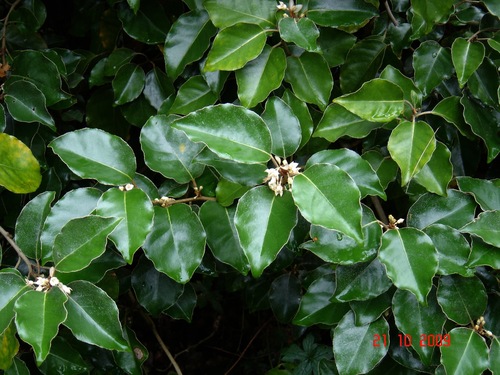
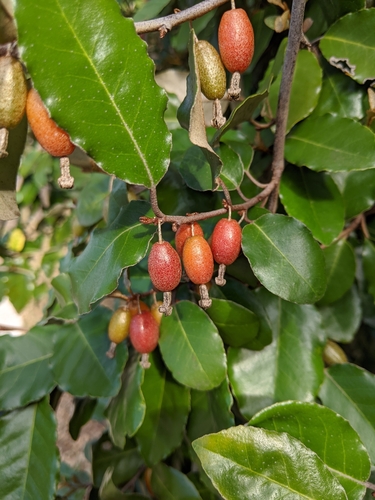
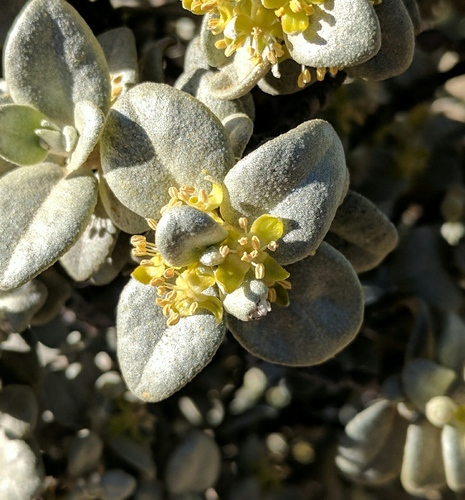
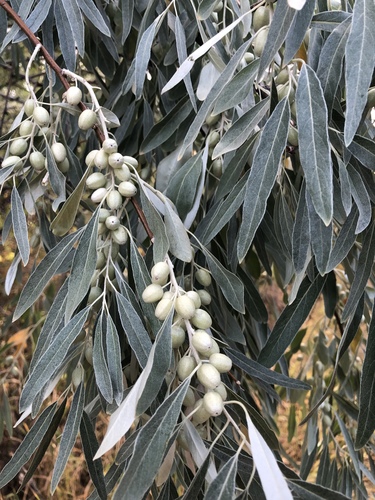
Elaeagnus angustifolia L. is a thorny tree that grows up to 11 metres (35 feet) in height. Its stems, buds, and leaves are covered in a dense layer of silvery to rusty scales. The leaves are alternate, lanceolate in shape, 4–9 centimetres (1+1⁄2–3+1⁄2 inches) long and 1–2.5 cm (3⁄8–1 in) broad, with smooth edges. Plants start producing flowers and fruit when they reach 3 years old. The highly fragrant flowers grow in clusters of 1 to 3, are 1 cm long, and have a four-lobed creamy yellow calyx. They bloom in early summer, and are followed by clusters of fruit: small cherry-like drupes 1–1.7 cm (3⁄8–5⁄8 in) long, orange-red and covered in silvery scales. Fruits are about 1 cm wide, have a sweet flavor, and a dry, mealy texture. The species establishes and reproduces primarily by seed, though some vegetative propagation also occurs. The thorns on its branches can grow from 2–7 cm (3⁄4–2+3⁄4 in) long.
Carl Linnaeus first scientifically described Elaeagnus angustifolia under its current name in 1753. Its common name comes from its visual similarity to the olive (Olea europaea), which belongs to the different botanical family Oleaceae. Per Sudnik et al. (2009), most authors agree that Elaeagnus angustifolia originated in the Irano-Turanian region. It is widely distributed across southwest Asia; to the east, its range extends from Kashmir and northwest India to eastern Kazakhstan. The western boundary of the species' natural distribution is unclear, and the natural origin of its stands in the lower Volga region (Golub et al. 2002) and Anatolia (Browicz 1996) has been questioned. Further east in Asia, its native range includes Afghanistan, Iran, Kazakhstan, Kyrgyzstan, Pakistan, Tajikistan, Turkmenistan, and the Caucasus nations. In India, it occurs in the western Himalayas, with a separate disjunct population in Myanmar and Assam in eastern India. It grows natively in Mongolia, and in China it is found in north-central regions, southeast China, Inner Mongolia, Manchuria, Qinghai, and Xinjiang.
This shrub has a high tolerance for salinity, which allows it to grow on bare mineral substrates and in poor, eroded soils and harsh environments. The caterpillars of the high-altitude alpine moth Lachana alpherakii use E. angustifolia as a host plant. Many bird species readily eat its fruit and disperse its seeds.
It is widely cultivated across southern and central Europe as a drought- and cold-resistant ornamental plant, valued for its scented flowers, edible fruit, attractive yellow foliage, and black bark. It was being grown in England by John Parkinson no later than 1633. In Iran, dried fruit powder mixed with milk is used to treat rheumatoid arthritis and joint pain. Evidence supports that an aqueous extract of Persian olive has beneficial effects in reducing osteoarthritis symptoms, with efficacy similar to that of acetaminophen and ibuprofen. It is one of the seven items used in Haft-sin, the traditional table setting for Nowruz, the traditional Persian spring celebration. The dried fruit, called senjed locally, is one of seven ingredients served in its own syrup in haft mēwa, a fruit salad eaten during Nowruz in Afghanistan. In folk herbalism, Russian olive has a wide range of uses, with leaves, fruit, flowers, and bark all employed. Leaves are used to support gastrointestinal health, assist wound healing, and are used as an antibacterial. Fruit has a variety of traditional applications, including use as an anti-inflammatory and antioxidant. Flowers are prepared as a herbal infusion to treat fevers. In urban settings, landscapers plant Russian olive to discourage unhoused people from resting or sleeping in the area.