About Elacatinus puncticulatus (Ginsburg, 1938)
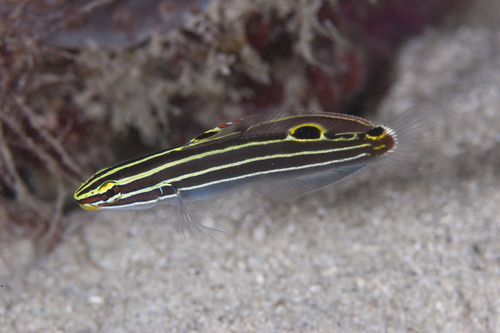
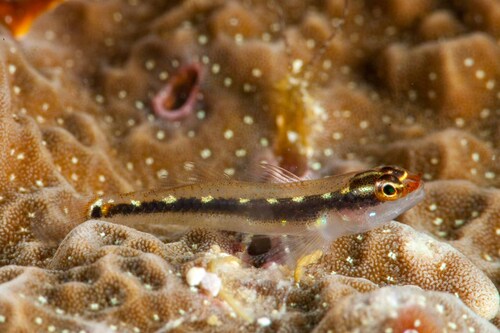
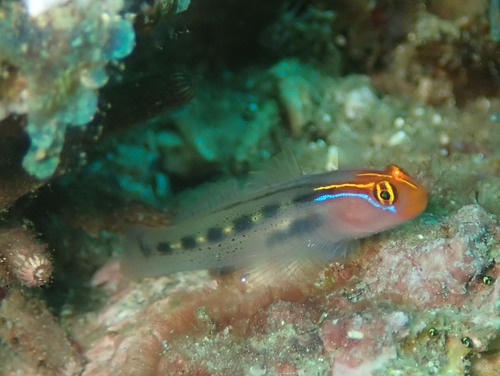
Elacatinus puncticulatus (Ginsburg, 1938) is a species of goby in the family Gobiidae, which is split into two genera: Elacatinus and Gobiosoma. The Elacatinus genus contains 25 species of goby fish, all sharing characteristics of 7 spines, 28 vertebrae, a compressed skull shape, and transparent fins. E. puncticulatus is the only species in this genus that has no scales on its head or body. This species is specifically marked by bold red and blue coloration on the head, yellow and black striping on the body, and a dark horizontal stripe behind the eye. A blue stripe near the head seen across many Elacatinus species is thought to be an adaptation that lets the fish attract 'client' fish, as members of the genus act as symbiotic cleaner fish. E. puncticulatus is sometimes divided into two main clades with further subclades, based on interspecific variation in both coloration and genetics. These variations are thought to have formed from oceanographic processes and habitat discontinuities that separated different E. puncticulatus groups over time. Depending on their geographic location, members of the species show different coloration on their head, body, and eye stripes, which can range from red to yellow-orange. Overall body size differs by sex: males reach around 30–40mm in length, while females only reach around 22–27mm. This sexual size difference becomes larger as latitude increases. Beyond geographic location, the species' role as a cleaner goby also affects its morphology. The Elacatinus genus typically has a terminal mouth position that matches its cleaner fish role, and E. puncticulatus specifically also has heterodont dentition, meaning it has more than one type of tooth shape. This trait separates it from other cleaner species in the genus, and is characteristic of its role as a facultative, or occasional, cleaner, rather than an obligate, or dedicated, cleaner. E. puncticulatus is a shallow-dwelling goby found along the continental shore of the Tropical Eastern Pacific (TEP), ranging from the southern tip of the California peninsula to southern Ecuador. Within this range, the species lives primarily between the subtidal zone and depths of 21m, on rocky or coral reefs. Their coral reef habitat acts as 'cleaning stations', and combined with the bright blue coloration on parts of their head, this allows the species to attract clients and feed on the ectoparasites they remove from client fish. It is the only species of the Elacatinus genus not found in the Atlantic, and only one of two species in the genus found in the TEP. Its distribution is shaped by habitat discontinuities that restrict its dispersal in the region; two muddy shore sections within the TEP are a notable example of this restriction. E. puncticulatus exhibits active courtship behavior before spawning and parental behaviors after spawning. Before spawning, male E. puncticulatus develop a gray head and yellow and black body coloration, instead of their typical red and blue head coloration. One day before spawning, males move their pectoral fins to clean their burrow, and display heavy breathing to signal they are ready. Female E. puncticulatus normally have strong red and black coloration, but turn pale three days before spawning. Males can identify that a female is ready to spawn because her urogenital region changes from brown to red the day before spawning. The Elacatinus genus is primarily gonochoristic, meaning individuals do not change sex, and often maintain stable monogamous pair bonds throughout their lives. E. puncticulatus lays benthic eggs that hatch into pelagic larvae. Male E. puncticulatus clean dead eggs after hatching, but sometimes clean eggs before hatching, which causes up to 50% egg loss. E. puncticulatus produces around 150 eggs per spawn, but only approximately 100 of these eggs successfully hatch to produce pelagic larvae. The eggs range in size from 0.4 to 0.7mm. A heartbeat can be detected 120 hours after fertilization (5 days), which is the period when embryos grow most rapidly and experience the highest mortality. Spontaneous hatching takes roughly an hour and a half to complete, and occurs 168 hours after fertilization (7 days). The incubation and embryonic development stages of E. puncticulatus are similar to those of Elacatinus figaro. Many aspects of the E. puncticulatus larval stage remain unknown, including larval distribution and how much time the species spends in the pelagic larval stage; however, closely related Elacatinus species have a pelagic larval stage ranging from 21 to 38 days. E. puncticulatus is found on corals on the TEP continental shelf. It often lives in association with sea urchins, though the reason for this association is not yet determined. The Elacatinus genus feeds primarily on ectoparasites collected through cleaning and cellular fish debris, and E. puncticulatus follows this pattern. Both males and females engage in cleaning behavior. Cleaning gobies may exhibit cheating behavior when cleaning with a partner, where they eat scales and mucus from clients instead of only ectoparasites, though this behavior is uncommon in the Elacatinus genus. When cleaning with a partner of the opposite sex, males modify their behavior to become more cooperative, while females retain their usual behavior. Clients in this cleaning mutualism are either non-predatory fish like parrotfishes, or piscivorous fish that are potential predators of the goby, such as longfin damselfish, yellowtail damselfish, and graysby grouper. While some clients are predatory to E. puncticulatus and other cleaner gobies, predatory clients are often cleaned immediately upon arrival, which may help identify the goby as a cleaner and reduce predation risk. Even though immediate cleaning of predatory clients may lower predation risk, it does not provide any foraging benefit: predatory and non-predatory clients provide the same amount of ectoparasites, and the presence of predatory clients often reduces the number of visits from more abundant non-predatory clients.