About Eira barbara (Linnaeus, 1758)
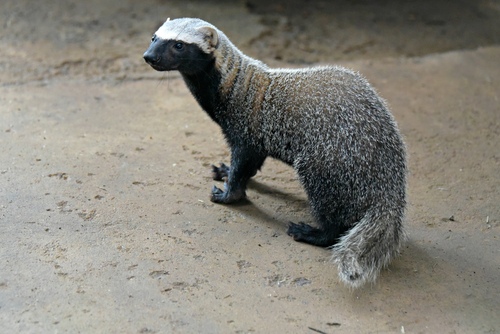
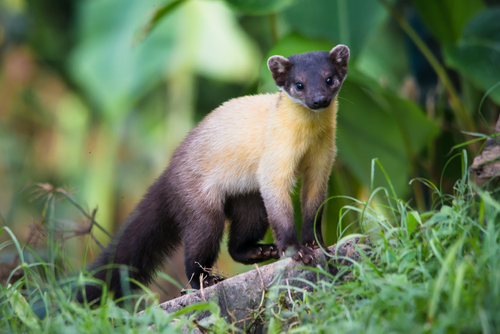
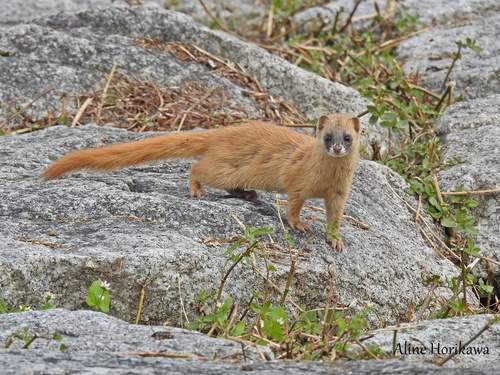
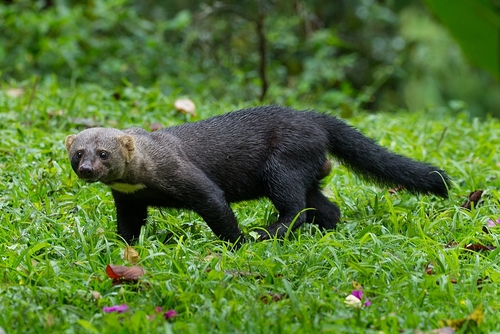
Tayras (scientific name Eira barbara (Linnaeus, 1758)) are long, agile mustelids. They resemble a large fisher or marten, but are more similar to a sleeker, smaller wolverine. Excluding their bushy tail, tayras measure 56 to 71 cm (22 to 28 in) in body length; their tails add an extra 37 to 46 cm (15 to 18 in). Adults weigh 2.7 to 7.0 kg (6.0 to 15.4 lb), with males being larger and slightly more muscular than females. Tayras have short, dark brown to black fur that is mostly uniform in length and color across the body, limbs, and tail. The only exception is a yellowish or orange heart-shaped patch on the chest; every individual tayra has a unique chest patch in color, shape, and size, which allows biologists, rescuers, and other specialists to identify individual animals. The fur on the head and neck is lighter, typically tan or greyish. Genetic color morphs such as albino, white, or beige-yellow individuals are documented, and these morphs are far less rare in tayras than in other mustelids. A tayra's feet have toes of unequal length; when held together, the toe tips form a strongly curved line. Their claws are short, curved, and strong, adapted for climbing and running rather than digging. The foot pads are hairless, but surrounded by stiff sensory hairs. Tayras have small, rounded heads, long sensory whiskers, and black eyes that have a blue-green shine. Like other musteloids, tayras have anal scent glands, but these glands are not as large, and their odor is not as pungent, as those of other related species. Tayras usually only use scent marking to mark territory and identify other nearby animals, rather than as a self-defense tactic, which contrasts with how skunks use scent. Tayras are distributed across most of South America, excluding Chile, Uruguay, most of Argentina (only far northern Argentina is included), and parts of the Brazilian east coast. Their range covers all of Central America, starting in Mexico: they reach as far north as Tamaulipas and Veracruz on the east coast, and southern Sinaloa and Nayarit on the west coast, then extend south to Panama. They also live on the island of Trinidad. Tayras are generally found only in tropical and subtropical forests, though they may cross grasslands or other open habitats at night when moving between separate forest patches. They are also observed in cultivated areas, tree plantations, and farmlands. Tayras breed year-round. Females enter estrus multiple times per year, with each estrus period lasting 3 to 20 days. Unlike some other mustelids, tayras do not have embryonic diapause. Gestation lasts 63 to 67 days. Females give birth to litters of one to three young, and care for the offspring alone. Newborn tayras are altricial: they are born blind with closed ears, but are already fully covered in black fur, and weigh around 100 g (3.5 oz) at birth. Their eyes open between 35 and 47 days old, and they leave the den shortly after this. They start eating solid food around 70 days old, and are fully weaned by 100 days old. Hunting behavior can start as early as three months old. Initially, the mother brings wounded or slow prey to her young so they can practice improving their killing technique. Young tayras are fully grown at around 6 months old, and leave their mother to establish their own territory by 10 months old.