About Eidolon helvum (Kerr, 1792)
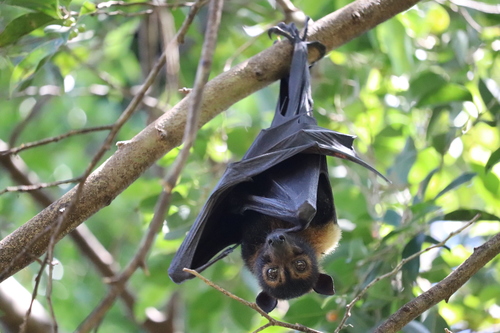
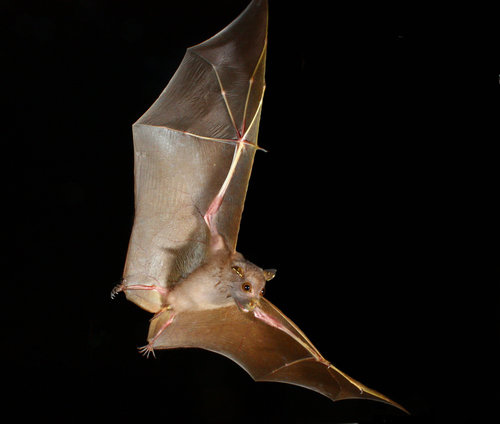
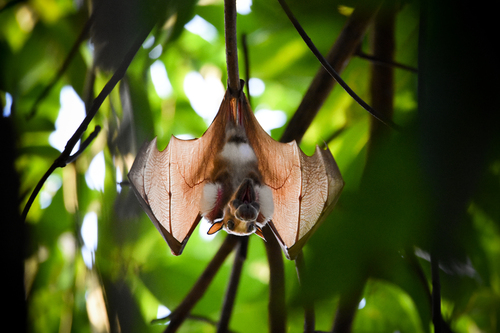
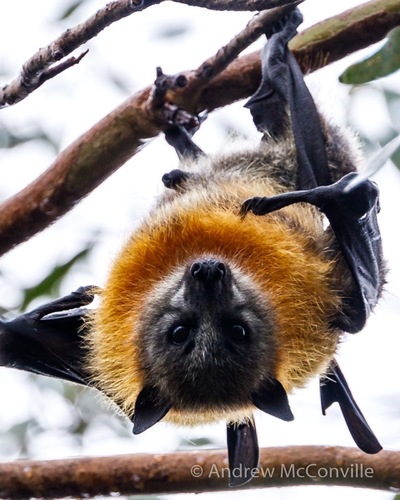
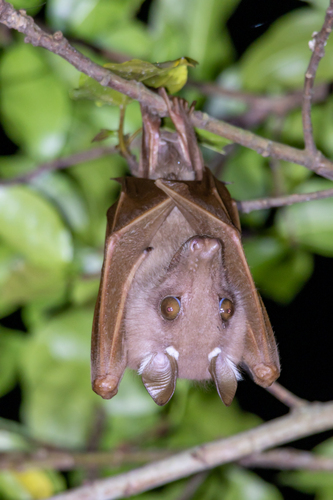
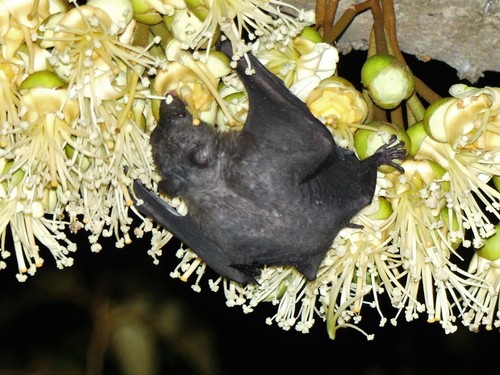
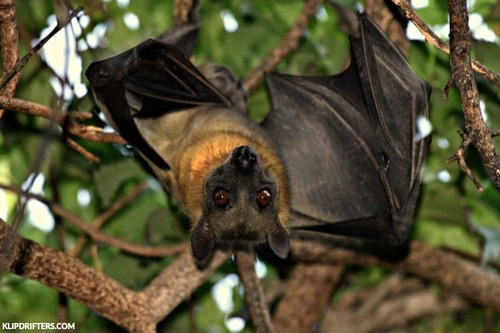
The straw-coloured fruit bat, scientifically named Eidolon helvum (Kerr, 1792), gets its common name from the silky yellowish or straw-colored fur across its body. Its wings are black, while the fur on its back is pale and tawny. In general, males have bright orange fur and females have yellowish fur. This species has large cheeks, large eyes, and large ears, with cheeks that are also notably large and pouch-like. Adults weigh an average of 230 to 340 g (8 to 12 oz), grow 14 to 23 cm (5.7 to 9 in) in body length, and can have a wingspan reaching up to 76 cm (30 in). Males are typically larger than females. The species has a very large heart, and its wings are long with tapered tips. This fruit bat is the most widely distributed fruit bat in Africa, and possibly the most widespread in the world. It occurs primarily across sub-Saharan Africa, in many forest and savanna zones, as well as around the southwestern Arabian Peninsula. It can also live in urban areas, at altitudes up to 2,000 m (6,600 ft), and prefers to roost in tall trees. The straw-coloured fruit bat is a highly social species. Colonies usually number over 100,000 individuals, and can sometimes reach almost one million bats. At night, bats leave the roost in smaller groups to locate food using their vision and sense of smell. They have been observed chewing soft wood to obtain moisture. This species contributes to pollinating flowers and dispersing seeds through forests, and is the main seed dispersal agent for Milicia excelsa, an increasingly rare and economically important African teak tree. Although they feed at night, straw-coloured fruit bats are not strictly nocturnal; they rest and move within their colony during the day. They return to the same feeding sites each year and each season, returning to locations they used previously. Their mating season runs from April to June, and mating is not synchronized across the population. Implantation is delayed until October, and all females undergo implantation during this synchronized window. The delay aligns with one of the two dry seasons that occur in the species' range. Births take place in February and March.