About Egretta sacra (Gmelin, 1789)
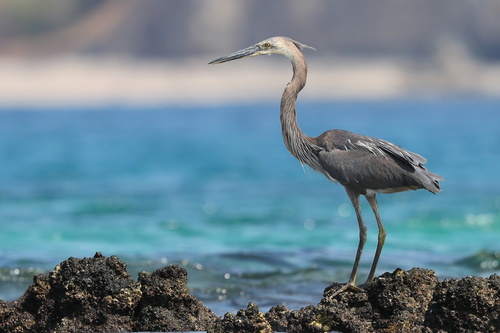
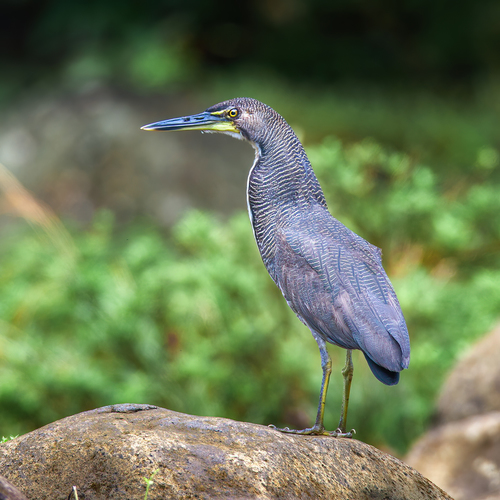
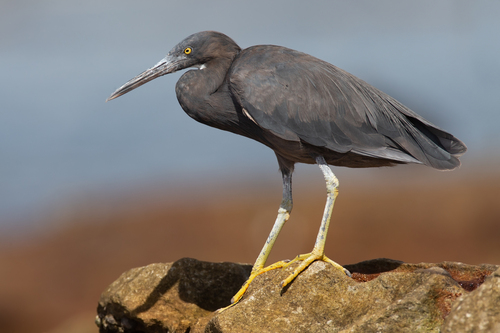
Pacific reef herons (scientific name Egretta sacra (Gmelin, 1789)) are medium-sized herons. They measure 57 to 66 cm (22 to 26 in) in length, have a wingspan between 90 and 110 cm (35 and 43 in), and reach an average weight of 400 g (14 oz). This species has unusual non-sexual dimorphism: some individuals have entirely white plumage, called the 'light' morph, while a larger share of individuals are charcoal-grey, called the 'dark' morph. The cause of this color variation, or morph, is unknown, though it is most commonly thought to be connected to camouflage. Immature Pacific reef herons typically have browner, duller colored plumage. Pacific reef herons have yellow-grey legs; grey morph individuals have a narrow white stripe marking their throats and chins. They have brown beaks, gold-yellow eyes, and the skin around their faces usually has a greenish to yellow tint. The Pacific reef heron is widely distributed across southern Asia and Oceania. In Australia, it inhabits most of the coastline and offshore islands, including the Torres Strait Islands. It is widespread across Micronesia, with confirmed breeding records in Guam, the Marshall Islands, the Northern Mariana Islands, Palau, and other islands there. The species also breeds across all of western Polynesia, including Fiji, French Polynesia, and Tonga, but it does not breed in Niue. Surveys of Rotuma, a Fijian island, carried out in 1991 and 2018 indicate that the Pacific reef heron has only recently colonized the island. New Zealand marks the southern limit of the Pacific reef heron's distribution. While it is relatively uncommon there, the herons are found across the whole country, and are most common in Northland. The diet of Pacific reef herons consists mainly of different marine fish, crustaceans, molluscs, and worms. This heron hunts during both day and night, with its activity tied to the rise and fall of tides. During the day, it hunts in shallow water, standing motionless with its wings held open like an umbrella to cut down on water reflections and create shade that attracts fish.