About Egretta novaehollandiae (Latham, 1790)
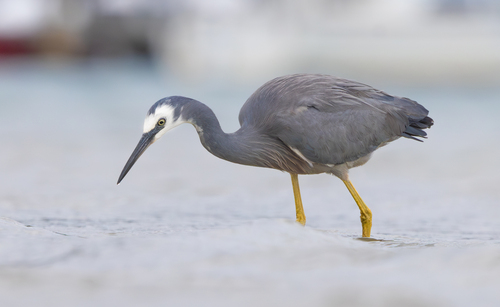
The adult white-faced heron (Egretta novaehollandiae) is medium-sized for its family, with mostly pale blue-grey plumage. Its forehead, crown, chin, and upper throat are white. Crown patterning varies between individuals: white occasionally extends down the neck, and this variation allows individual identification. The iris can be grey, green, dull yellow, or cinnamon. The lores (the area between the eye and bill on the side of the head) are black. The beak is black, often with a pale grey base. During the breeding season, pinkish-brown or bronze nuptial plumes grow on the foreneck and breast, while blue-grey plumes develop on the back. Adults typically weigh 550 g (1.21 lb) and stand 60 to 70 cm (24–28 in) tall. Immature birds are paler grey, with only the throat being white, and often have reddish colouring on the underparts. Chicks are usually covered in grey down.
The white-faced heron occurs across most of Australasia, including New Guinea, the Torres Strait islands, Indonesia, New Caledonia, New Zealand, Subantarctic islands, and all but the driest regions of Australia. The species is currently resident on Christmas Island, though no breeding has been recorded there. It is also commonly found on Lombok, Flores, and Sumbawa, and has been recorded as a vagrant in China, the Cocos Islands, and the Solomon Islands. It is mostly a winter visitor to the Northern Territory of Australia. It self-introduced to New Zealand in the late 1940s, and it is the only heron species recorded breeding in Tasmania. Locally nomadic, the white-faced heron inhabits both fresh and saltwater wetlands, farm dams, pastures, grasslands, croplands, shores, saltmarsh, tidal mudflats, boat harbours, beaches, golf courses, orchards, and garden fish ponds. It is protected in Australia under the National Parks and Wildlife Act 1974.