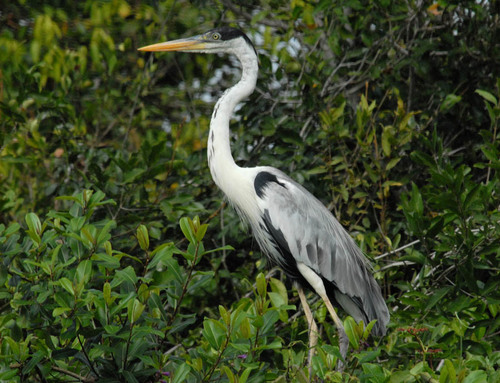
About Egretta gularis (Bosc, 1792)
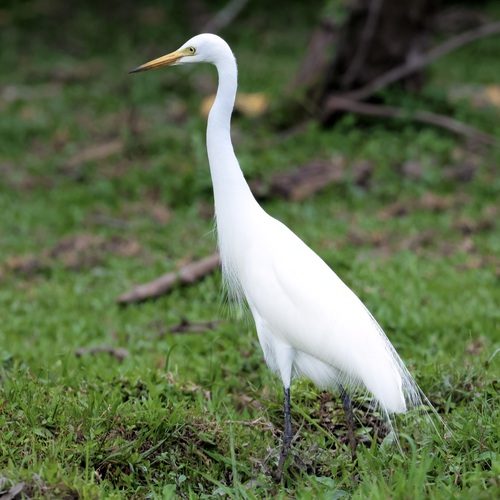
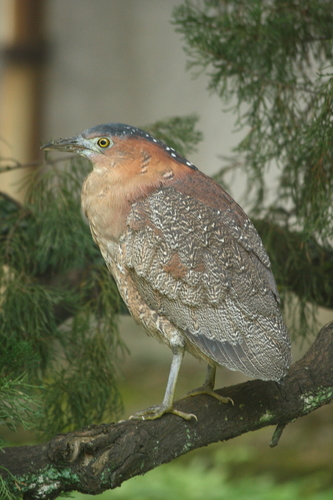
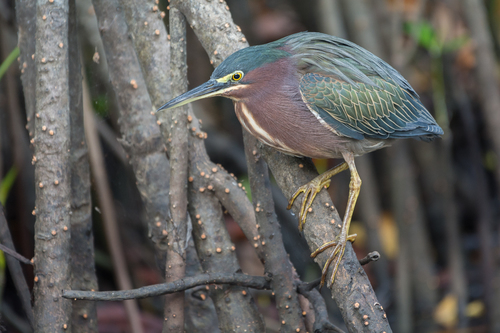
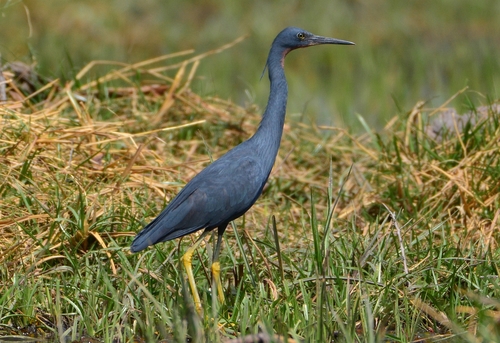
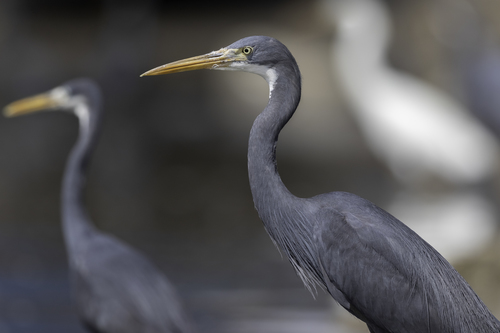
Egretta gularis (Bosc, 1792), commonly called the western reef heron, has two primary plumage color forms: an all-white morph and a dark grey morph. Intermediate grey shades, which may be linked to age, and grey-and-white particolored plumage can also occur. The white morph resembles the little egret in general appearance, but differs in having a larger, yellower bill, more extensive yellow coloration on thicker legs, and very active foraging behavior that sometimes includes moving or shading the water surface with a wing. The grey morph has a whitish throat, with a bill and legs similar to the white morph, and is unlikely to be confused with any other species within this egret's range. During the breeding season, the legs and facial skin turn reddish, and breeding individuals grow two long feathers on the sides of the nape. There are two widely recognized subspecies. The nominate subspecies E. g. gularis ranges from West Africa to Gabon, with a small number of birds breeding in southern Europe. It has a more pointed bill than the other subspecies. Subspecies E. g. schistacea (Hemprich & Ehrenberg, 1828) breeds from the Persian Gulf along India's coast to the eastern end of the Indian Peninsula, and has a larger bill that is particularly wide toward the base. The population on the eastern coast of South Africa is usually separated as the distinct species dimorphic egret, Egretta dimorpha. The dark and white morphs of Egretta gularis are thought to be controlled by a single allele, with the dark character incompletely dominant over the allele for white plumage. This species occurs mainly on tropical coasts, ranging from West Africa through the Red Sea and Persian Gulf (Iran) east to India. It is also found in the Lakshadweep Islands and Sri Lanka, where breeding was once recorded at Chilaw. The nominate subspecies breeds in West Africa from Mauritania to Gabon, and can sometimes be found outside the mainland, for example in the Canary Islands; small numbers breed in Spain. Subspecies schistacea occurs from the Red Sea coast eastward around the Indian coast, and breeding colonies are known from India's east coast near Pulicat Lake. Individuals occasionally range further inland. The nominate subspecies occurs as a vagrant in North America, South America, and the Caribbean islands. A growing number of records leads to suspicion that this subspecies may establish breeding colonies in Brazil. Several records from Germany, Austria, and France between 1980 and 1990 have been linked to birds that escaped from an animal dealer in Mittelfranken. Western reef herons stalk their prey in shallow water. They often run or stir the water with their feet, or flick their wings to disturb prey, but may also stand still to ambush prey. Their diet includes fish, crustaceans, and molluscs, and they regularly feed on mudskippers in coastal areas. Laboratory studies show the species is capable of correcting strikes for light refraction at the water surface, but the probability of missing a target increases when striking at prey at very acute angles to the surface. Like other herons and egrets, they have few vocalizations, producing only a low kwok or grating sounds when disturbed or near the nest. The western reef heron's breeding habitat is coastal wetlands. In the Red Sea region, the breeding season runs from June to August. The nominate subspecies breeds in West Africa from late April to September. In India, breeding occurs during the monsoon rains from April to August. At the former Chilaw breeding colony in Sri Lanka, breeding runs to the end of May. Most breeding colonies in Gujarat, western India, are located in mangroves. They nest in colonies that are usually made up of only their own species, but sometimes include other egrets and smaller herons. Nests are stick platforms built in trees or shrubs. Males collect the nest sticks, while females arrange them to form the platform. Nest heights generally range from about 5 to 15 meters, but nesting as low as 0.6 meters has been observed in mangrove trees growing in salt pans. The usual clutch is three to four light blue eggs, matching the egg color of the little egret. Incubation begins after the first egg is laid, which results in size disparities among hatched chicks. Both parents take turns incubating, and eggs hatch after about 23 to 24 days. Hatchlings are white with grey dappling. Young birds sometimes die after falling from the nest platform. Adults shade chicks during the hottest parts of the day. Rats prey on eggs, while cats and crows may take young chicks. Adults typically guard the nest when eggs or young chicks are present. Adults feed young by regurgitating semi-digested food at the nest, and this diet consists mainly of small fish from the families Clupeidae, Gobiidae, and Engraulidae. Young birds leave the nest approximately one month after hatching.