About Egretta caerulea (Linnaeus, 1758)
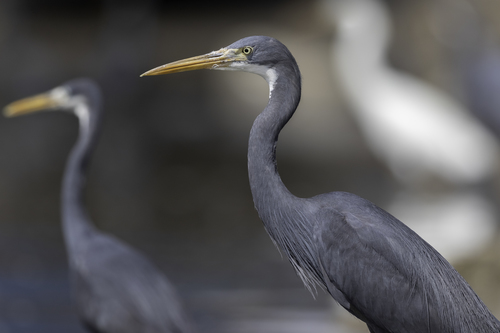
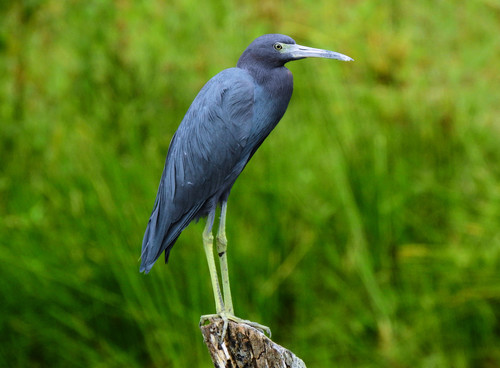
Little blue herons (Egretta caerulea) have identical coloration in males and females. Adults are dark-colored, with purple-maroon heads and blue bodies. During the breeding season, their heads turn dark red. They have two-toned bills: light blue at the base with black tips. Their eyes are yellow, and their legs are greenish. Juveniles are almost completely white, though the upper primaries are somewhat dark. Like adults, juvenile little blue herons have two-toned bills. Immature birds transitioning from the juvenile to adult phase have a mix of light and dark feathers. Both sexes measure about 56–74 centimetres (22–29 in) in length, with a wingspan of 100–105 centimetres (39–41 in), and weigh around 397 grams (14.0 oz). During breeding, the normally dull green lores turn turquoise, long plumes that extend 20–30 centimetres (7.9–11.8 in) past the tail develop on the crest and back, and the legs and feet turn black. Their eggs are typically smooth, light blue, and unmarked, measuring about 31.7–43.2 millimetres (1.25–1.70 in), and weighing around 23.1 grams (0.81 oz). Egretta caerulea is regularly found in the United States, Mexico, Central America, northern South America (including Venezuela, Colombia, and Peru), and many Caribbean islands (including Cuba, Jamaica, and Hispaniola). It has been recorded as a vagrant, a species appearing far outside its natural range, in Greenland, Portugal, and South Africa. It is unknown whether the species' overall range is declining. In the United States, it occurs from Missouri to Virginia to Florida, and is more common in peninsular Florida than in the Florida Panhandle. It can occasionally roam as far north as Canada. Individuals from central Alabama tend to migrate to South America and the Caribbean, while individuals from west of the Mississippi River travel to Mexico and Central America. One study found that among seven migratory wading bird species, the little blue heron had the greatest mean dispersal distance, at 1,148 kilometres (713 mi). Future climate change is projected to increase the species' overall range. If global warming continues at its current rate, by 2080 the little blue heron's summer range will have increased by 87%, and only 1% of its current range is expected to be lost. These range gains will expand its summer distribution well into more northern parts of the US, such as Michigan and Minnesota, and even into southern Canada. The little blue heron lives in both freshwater and marine environments, including mangrove forests, bogs, swamps, salt marshes, tidal flats, estuaries, streams, and flooded fields. It is usually found at low elevations, but can be seen at up to 3,700 metres (12,100 ft) in the Andes. In North America, it tends to prefer freshwater habitats, while in the Caribbean it is more often found in saltwater. At the southern extent of its range in Brazil, it is found almost exclusively along the coast and rarely ventures inland. When hunting, little blue herons prefer to stand still and wait for prey rather than chase it. They walk slowly to search for fish and other prey, and fly to new spots if needed. They tend to move more slowly than related species, which helps distinguish them. They are not usually found in large numbers at any single body of water, but they will occasionally gather with other herons, especially when a school of fish is trapped in shallow water. They sometimes also feed in grassy fields. During courtship, both males and females perform bill-nibbling behavior, and males also use a neck-stretch display to attract mates.