About Edalorhina perezi Jiménez de la Espada, 1870
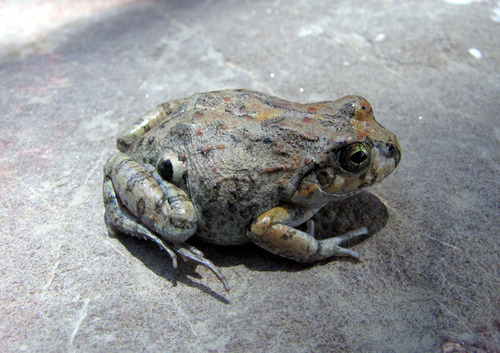
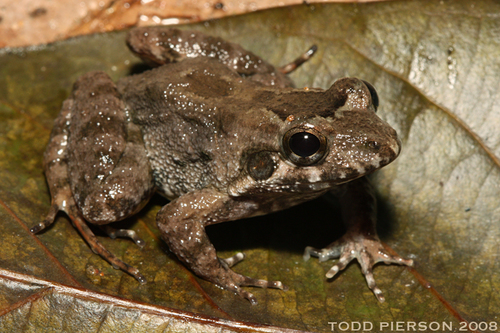
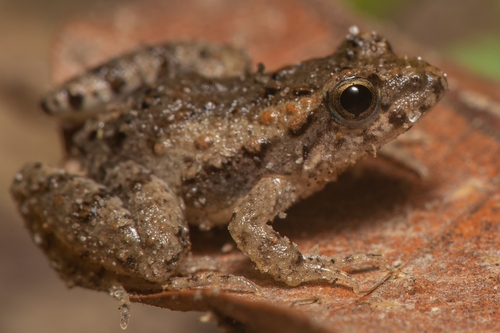
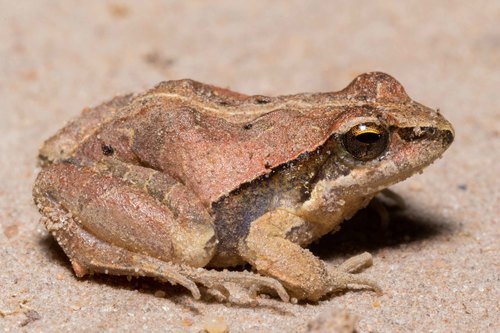
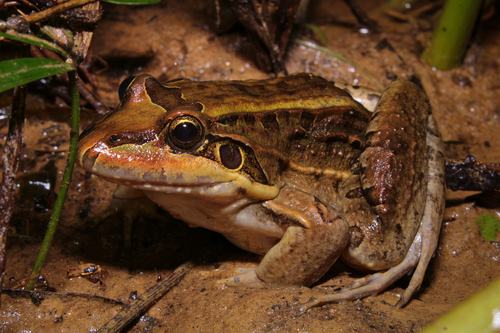
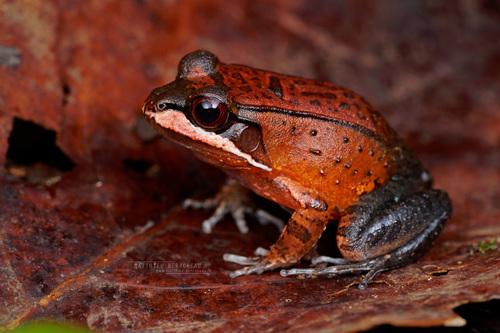
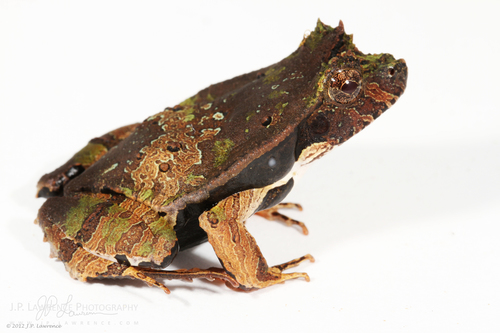
Edalorhina perezi, commonly called Perez's snouted frog, is a species of frog in the family Leptodactylidae. It is one of only two species in the genus Edalorhina. This species is diurnal and terrestrial, and during the mating season, both females and males gather around treefall pools. It is confirmed to occur in Brazil, Colombia, Ecuador, and Peru, with a possible presence in Bolivia. Its natural habitats are subtropical or tropical moist lowland forests, subtropical or tropical moist montane forests, and freshwater marshes. It is listed as Least Concern on the IUCN Red List, and its population is stable.
Studies have documented large morphological variation across populations of Perez's snouted frog. An early 1949 study conducted by Dunn that examined 52 specimens found dissimilarity in vomerine teeth and dorsal skin structure. Dunn classified the species into three morphs: perezi, plicifrons, and buckleyi. The perezi morph has a dermal ridge between the eyes and vomerine teeth, and lacks longitudinal warts on the back. The plicifrons morph has longitudinal warts, but lacks both vomerine teeth and a dermal ridge. The buckleyi morph is similar to plicifrons, but has vomerine teeth. Dunn also observed that certain morphs are more common in distinct parts of the species' range: for example, 86.6% of specimens from Ecuador belong to the perezi morph, while only 62.5% of Peruvian specimens are perezi. Other documented geographical differences include the presence or absence of vomerine teeth, and the development of a wart on the snout tip.
A later 1990 study by Duellman further investigated this geographical variation by examining dorsal skin structure and ventral color pattern. Duellman classified dorsal patterns into five categories based on smoothness, and found that each geographical area is dominated by populations of a specific pattern type. Ventral color was also classified into five groups based on the pattern of black and white patches, and the range of each group is highly correlated with the distribution of river systems, including the Rio Purus, Rio Madre de Dios, Rio Ucayali, and Rio Tapiche. A common explanation for the high morphological variation among populations of Perez's snouted frog is historical climatic-ecological changes. During the Pleistocene, rivers flowing down from the Andes carried a larger volume of glacial meltwater than they do today, which isolated the frogs into different basins and allowed these populations to evolve independently. Present-day pattern categories correspond to this historical geographical segregation.
Perez's snouted frog is commonly found in the upper Amazon Basin of Ecuador and Peru. Its sister species, E. nasuta, has a much smaller range and occurs only in Peru. Populations of E. perezi have also been documented in southern Colombia and Brazil. The species' range spans from basins at just 200 m elevation up to 1100 m on the eastern slopes of the Andes Mountains. As a diurnal, terrestrial frog, it typically inhabits leaf litter-covered forest floors in lowland tropical rainforests, and is well adapted to both primary and secondary forests.