About Ectophylla alba H.Allen, 1892
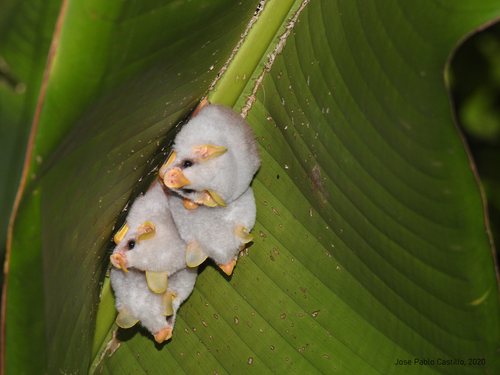
As both its common name and specific epithet suggest, the Honduran white bat (Ectophylla alba) has bright white fur. The tips of individual hairs are gray, and this grayish coloration becomes more pronounced toward the bat's posterior. Out of over 1,300 described bat species, this species is one of only a few currently known bats with entirely white pelage, alongside four Diclidurus species and the ghost bat Macroderma gigas. Its large nose-leaf easily distinguishes it from the northern ghost bat Diclidurus albus, the only white bat that shares an overlapping geographic range (is sympatric) with it. Its wing membranes are black, while its ears, tragi (cartilaginous projections in front of the ear openings), nose-leaf, and lips are a bright yellowish orange. This yellow-orange pigmentation comes from large concentrations of carotenoids, particularly xanthophyll, and this species is the first mammal known to have enough carotenoids in its skin to produce a conspicuous visible color. A 2019 study found that while the brightness of the yellow pigment on the ears did not differ significantly between adults and juveniles, the yellow chroma (colorfulness relative to brightness) of the ears did change with age: adult bats had higher yellow chroma in their ears than juveniles. Yellow coloration of the nose-leaf showed more variation. Adult males have brighter yellow nose-leaves than adult females, and there was no difference in nose-leaf brightness between juvenile males and females. Adult males also had significantly brighter nose-leaves than juvenile males. Just like with ear coloration, the yellow chroma of the nose-leaf was higher in adults than juveniles, with no difference between sexes. Study authors suggested that the color difference between male and female nose-leaves indicates sexual dichromatism, meaning females may preferentially choose males with brighter nose-leaves. This conclusion was supported by the observation that males with brighter yellow nose-leaves typically had better body condition, so females can use nose-leaf color as a reliable honest signal of male fitness when selecting a mate. A second 2019 study found that the distinctive yellow pigment may have been selected for due to the species' tent-roosting behavior. Ancestral state reconstructions confirmed that yellow coloration coevolved with tent-roosting. When sunlight passes through the green leaves that form the bats' roosting tents, it creates yellowish light; yellowish-colored bats gain more effective camouflage, making them more likely to survive, reproduce, and pass on the genes for yellow coloration to their offspring. The Honduran white bat is a small species, with a head and body length of 37–47 mm (1.5–1.9 in), a forearm length of 27.8–29.3 mm (1.09–1.15 in), and an ear length of 10–15 mm (0.39–0.59 in). Individual bats weigh only 5–6 g (0.18–0.21 oz). The bat has an erect nose-leaf, no tail, and large, rounded ears. The inner margin of the tragus is convex, while the outer margin is coarsely serrated with four or five small lobes. The nose-leaf also has a serrated margin, and 8 to 10 small "warts" sit under the bat's mouth. Its dental formula is 2.1.2.2 / 2.1.2.2, giving it a total of 28 teeth. Its skull is similar in appearance to other species in its subfamily, except for its very deep basioccipital pits. Overall, the bat resembles a small, white Platyrrhinus. The Honduran white bat occurs in several Central American countries: Costa Rica, Honduras, Nicaragua, and Panama. Unusually for leaf-nosed bats, most of which live in South America, it is one of only four leaf-nosed bat species endemic to Central America. Its range covers elevations from 0 to 700 m (0 to 2,297 ft) above sea level, and it prefers wet evergreen forests and secondary forests that can meet its specific roosting and dietary requirements. Little is known about the Honduran white bat's reproductive behaviors. It has been proposed that individuals give birth in April and September, and that estrus occurs after parturition. In Costa Rica, pregnant females have been recorded in February, March, June, July, and August, while lactating females have been recorded in March and April. Females have synchronized births, with all births in a single colony happening within the same week. Females give birth to only one offspring, called a pup. During lactation, mothers return to their roosts up to six times per night to nurse their pups. Pups fledge (become capable of flight) at 3–4 weeks old.