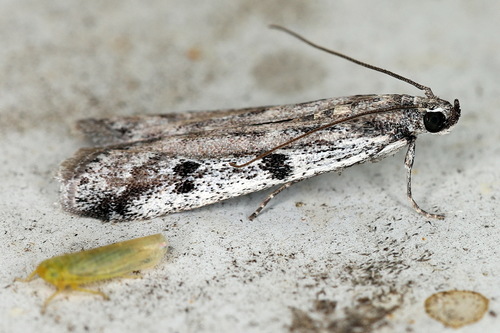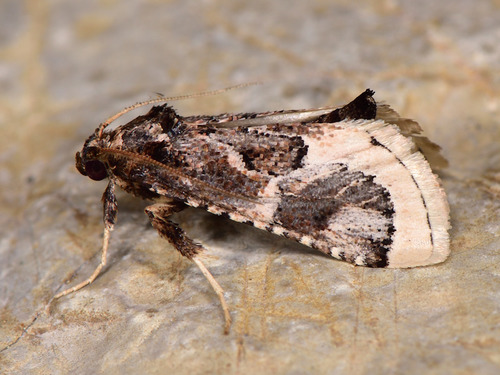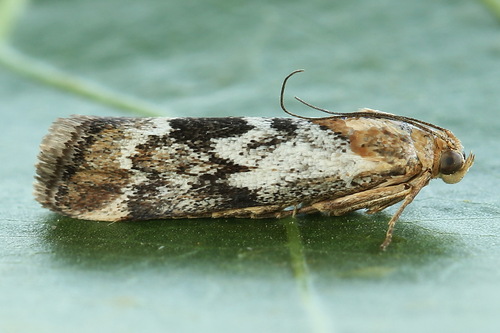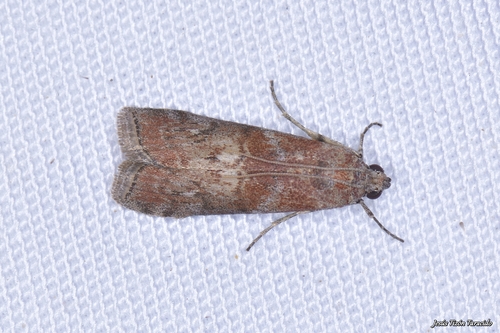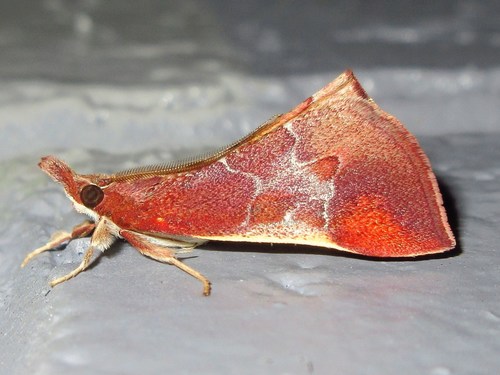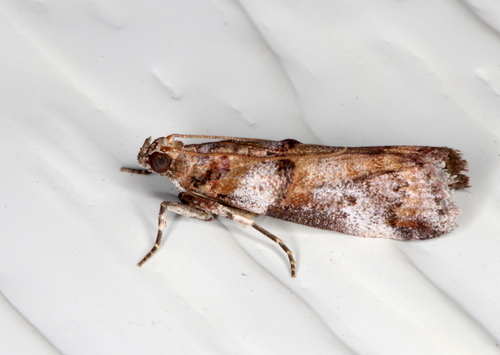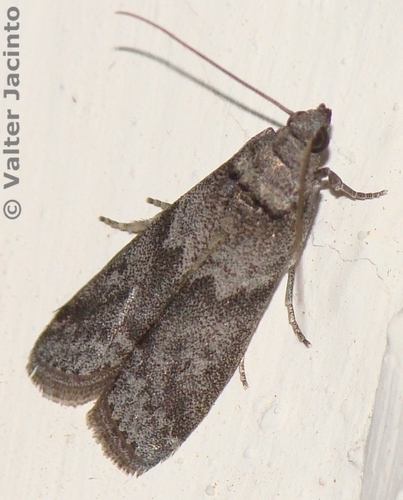
About Ectomyelois ceratoniae Zeller, 1839
Ectomyelois ceratoniae, commonly called the locust bean moth or, more ambiguously, the carob moth, is a moth species in the family Pyralidae with an almost cosmopolitan global distribution. The larvae of this species are translucent white, with their internal organs visible from the outside. These larvae feed on the seeds and pods of a wide variety of plants, including Punica granatum, citrus fruits, Pistacia vera, Juglans regia, Prunus dulcis, Macadamia integrifolia, Acacia farnesiana, Caesalpinia sappan, Cassia bicapsularis, Ricinus, Erythrina monosperma, Haematoxylum campechianum, Prosopis juliflora, Samanea saman, Phoenix dactylifera, and Ceratonia siliqua. It is a major agricultural pest, and is recognized as the most economically damaging pest for California’s date industry. It also causes damage to many other high-value nut and fruit commodities around the world, including almonds, pistachios, macadamias, pomegranates, stone fruits, and pome fruits. Pheromone mimic lures for this species are available commercially. In 2007, California’s date (Phoenix dactylifera) industry produced 17,700 tons of dates across 5,900 acres, with a total gross value of approximately $31.86 million. Over the 25 years before this data was collected, the locust bean moth caused annual damage to between 10% and 40% of harvestable date crops, equal to around $3.1 million to $12.7 million in annual economic losses, which does not include pest control costs. Until recently, the only available method for controlling locust bean moth was dusting with malathion, applied three to four times per growing season. Because date palm trees can reach heights of over 50 feet, commercial pest control treatments had to be applied using powerful dusting equipment that delivered insecticidal dust through a hand-directed tube. This application method creates an insecticide fog that covers the entire ground with malathion, which is wasteful, causes unintended harm to non-target animal species, and creates environmental pollution. Additionally, malathion dust that accumulates on date skins causes unwanted fruit desiccation, which reduces the overall quality of the harvested product. As date gardens have become encroached upon by expanding urban areas, California date producers have needed to stop using malathion dusting, but until recently there were no alternative control options available for locust bean moth. The mimic pheromone used in monitoring lures provides a viable nontoxic alternative for locust bean moth control. When this mimic pheromone is formulated into SPLAT, it can be used to control moth populations via mating disruption in date gardens, as well as pomegranate and almond orchards. Extensive field trials with the pheromone mimic formulations SPLAT EC and its organic version, SPLAT EC-Organic, have confirmed that a single application of the formulation delivers effective season-long control of locust bean moth populations in date gardens. Both SPLAT EC and SPLAT EC-Organic are used as preventive measures to protect growing areas from locust bean moth infestation. These products do not kill moths; instead, they control populations by disrupting moth mating via the pheromone mimic volatiles emitted by the formulations. For this reason, proper application timing to target the moth’s mating season optimally is very important.