About Eclipta prostrata (L.) L.
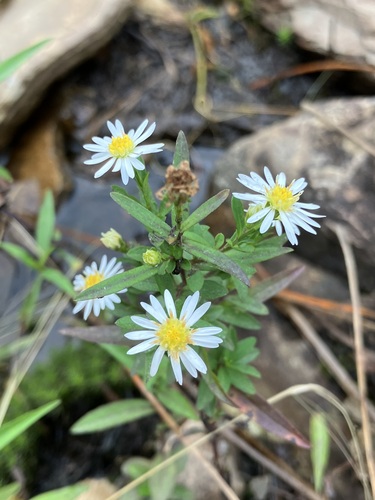
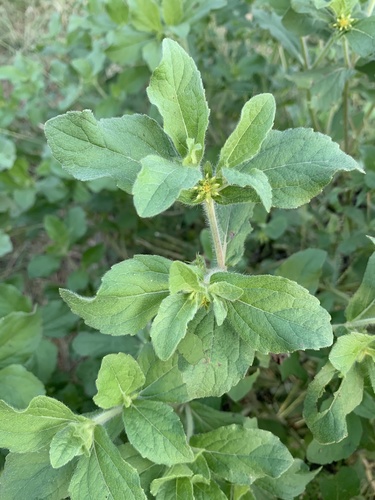
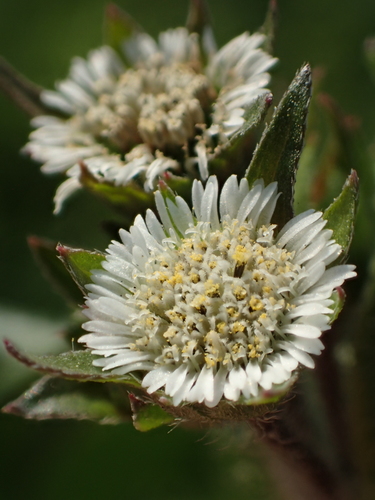
Eclipta prostrata, commonly called false daisy, is a plant species belonging to the family Asteraceae. It is native to North and South America, and is now widespread across much of the world. This plant grows commonly in moist locations in warm temperate to tropical areas worldwide. Its typical habitats include marsh edges, lake shores, river banks, brackish marshes, and cypress depression swamps. False daisy has cylindrical, grayish roots. Its stems are solid, circular, purplish, covered in fine white hairs, and reach up to 0.8 meters in height. Its leaves are arranged in opposite pairs, hairy on both sides, lanceolate, and serrated; they measure 2–12.5 cm long and 5–35 mm wide. Its solitary flower heads are 6–8 mm (0.24–0.31 in) in diameter and bear white florets. Its achenes are bumpy, compressed, and narrowly winged. This plant has documented traditional uses in Ayurveda. In Hindi-speaking regions of India, it is called bhangra or bhringaraj; the related species Wedelia calendulacea shares these common names, so white-flowered Eclipta alba is referred to as white bhangra, and yellow-flowered Wedelia calendulacea is called yellow bhangra. In Southeast Asia, the dried whole plant is used in traditional medicine, though there is no high-quality clinical research to confirm these uses are effective. Balinese people cook false daisy as a vegetable. In Java, people consume this herb, locally called orang-aring or urang-aring, as part of their lalap dish. Until the 1970s, Javanese also made an infusion of the herb in coconut oil to create a popular hair oil. Extracts from its leaves are used as a black hair dye and in tattooing.