About Echium pininana Webb & Berthel.
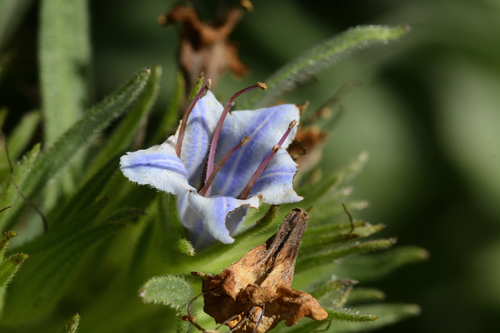
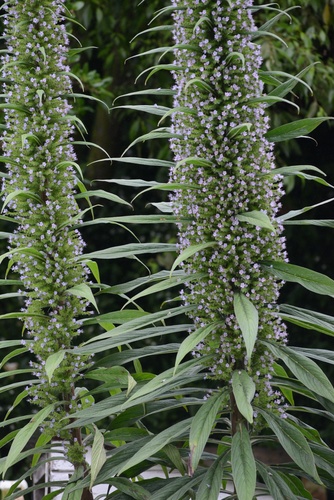
Echium pininana Webb & Berthel. is a monocarpic flowering plant with a multi-year growth cycle. In its first year, it forms a basal rosette of lanceolate leaves roughly 7 cm (3 in) long covered in silver hairs, and also develops a 0.9–2.4 m (3–8 ft) tall trunk covered in many additional lanceolate leaves. In its second or third year, it grows a cone-like inflorescence that can reach up to 4 m (13 ft) in height, packed with a dense mass of leaves and small blue flowers. Between April and June, the flower spike can grow 5 cm (2 in) per day. Individual flowers are funnel-shaped, each producing up to 1.4 μL of nectar that is around 26% sugar. Flowers open sequentially from the bottom of the flower spike to the top. Pollinators including bees, butterflies, and moths are attracted to these flowers. After pollination, each flower produces four nutlets. A single plant can produce over 200,000 seeds, which are dispersed short distances by wind. This species is endemic to the island of La Palma in the Canary Islands, where it grows in laurel forests. It is classified as endangered due to agricultural activity-driven habitat loss. Outside of its native range, it has been introduced to France, Great Britain, Ireland, New Zealand (both the North and South Islands), and the United States (the north and central coast of California). It is maintained in ex situ conservation, and the ex situ conservation population is larger than the remaining wild population. It is conserved in botanical gardens including London's Kew Gardens, where it has naturalized. Echium pininana is cultivated as a garden ornamental, and has earned the Royal Horticultural Society's Award of Garden Merit. It is used as a bedding plant or planted in garden borders, and grows best in full sun. Cultivation is recommended for the southern maritime counties of England, the Channel Islands, and the Scilly Isles. There are documented reports of successful cultivation in the English Midlands and Yorkshire, when grown in favourable locations. Specimens are also grown in Dublin gardens at Howth, and in the Irish National Botanic Gardens at Glasnevin. The plant grows readily in North Wales, where it seeds very widely. In Britain and Ireland, Echium pininana is considered half-hardy. It readily self-seeds to form clusters of plants, and it has been suggested that natural selection will eventually produce a hardier cultivated variety. The plant is most vulnerable to frost damage during its first year of growth. Its large semi-mature leaves also make it highly susceptible to wind damage, so a sheltered position in the garden is essential. There is one known cultivated cultivar, Echium pininana 'Alba', which produces white flowers.