About Echis carinatus (Schneider, 1801)
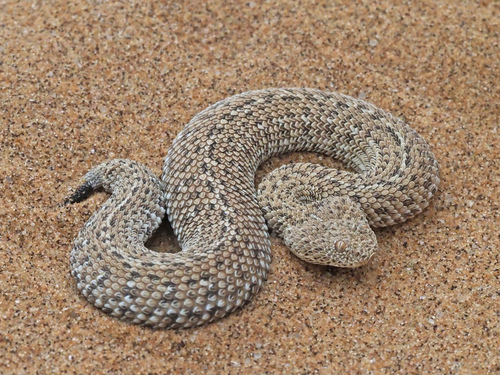
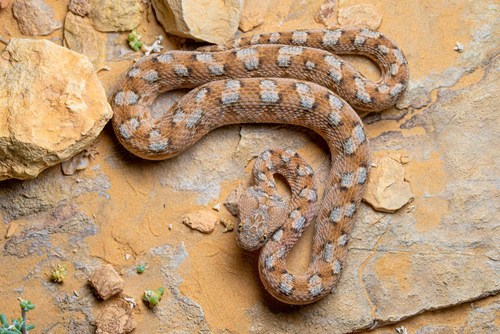
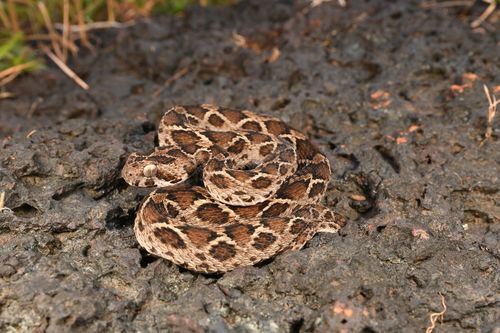
Echis carinatus (Schneider, 1801) measures between 38 and 80 cm (15 and 31 in) in total body length including the tail, and most individuals do not exceed 60 cm (24 in) in total length. Its head is clearly distinct from its neck, with a very short, rounded snout. The nostril is positioned between three scales, called shields. The head is covered in small keeled scales, and an enlarged supraocular scale is sometimes present among these. There are 9 to 14 interocular scales across the top of the head, and 14 to 21 circumorbital scales. The eye is separated from the supralabials by 1 to 3 rows of scales. There are 10 to 12 supralabials, the fourth of which is usually the largest, and 10 to 13 sublabials. This species is endemic to Asia. On the Indian subcontinent, it occurs in India, Sri Lanka, Bangladesh, and Pakistan, including Urak near Quetta and Astola Island off the coast of Makran. In the Middle East, it is found in Oman, Masirah Island, eastern United Arab Emirates, Iraq, and southwestern Iran; additional confirmed records of this species in Iraq come from the Thiqar and Kirkuk governorates. In Central Asia, it is present in Afghanistan, Uzbekistan, Turkmenistan, and Tajikistan. The original 1801 description by Schneider did not include a type locality, but Russell (1796:3) listed "Arni", India as a locality. Echis carinatus occurs on a range of different substrates, including sand, rock, and soft soil, and is found in scrubland habitats. It often hides under loose rocks. In Balochistan, specimens have been recorded at altitudes up to 1982 m. The Indian population of Echis carinatus is ovoviviparous. In northern India, mating occurs in winter, and live young are born between April and August, though occasional births have been recorded in other months. Litters usually contain 3 to 15 young, each measuring 115–152 mm in length. Mallow et al. (2003) report that the maximum recorded litter size is 23.