About Echiopsis curta (Schlegel, 1837)
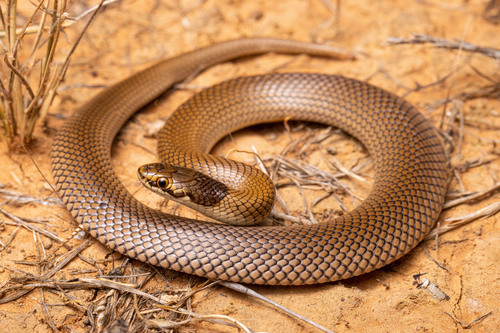
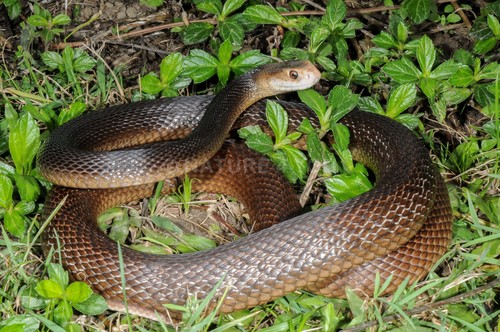
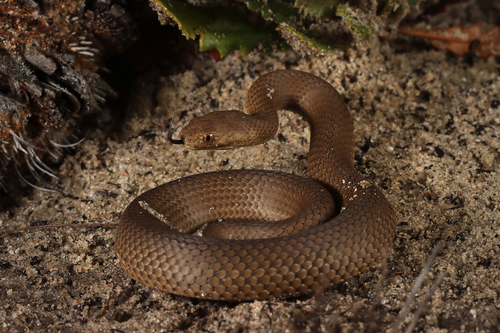
The bardick, whose scientific name is Echiopsis curta, reaches a maximum total length of 57 cm (22.4 in). It has a thick, stumpy body and a short tail, with smooth scales. Its base color ranges from pale to dark grey, brown, or reddish, and it is darker along the head and back, lightening toward the sides; its belly is white to cream, and its lips have white spots. The bardick has short, hollow, fixed fangs that it uses to inject toxic venom into its prey. Echiopsis curta has three separate distinct populations in semi-arid regions of southern Australia: one in south-western Western Australia, one on the Eyre Peninsula of South Australia, and one in western Victoria and New South Wales. Western populations inhabit heath, scrubland, and open forest, while eastern populations prefer mallee and Triodia grassland habitats. Bardicks shelter under leaf litter, fallen trees, and other debris. The main threat to bardick populations is habitat loss caused by land clearing. Bardicks are ovoviviparous. Litters range in size from 3 to 14 young, with an average of 7, and newborn bardicks measure up to 15 cm in length. Mating takes place in late spring, gestation occurs over the summer, and birth happens in late summer and autumn. Males reach sexual maturity at a snout-vent length (SVL) of 29 cm, when they are between 17 and 19 months old. Females reach sexual maturity at a snout-vent length of 28 cm, at approximately 32 months of age. An individual's body size is strongly correlated with its reproductive fitness. This species has among the largest litter volumes recorded for snakes: a single 41 cm SVL specimen carried 13 full-sized embryos that extended 34 cm internally, reaching to 7 cm from the snout.