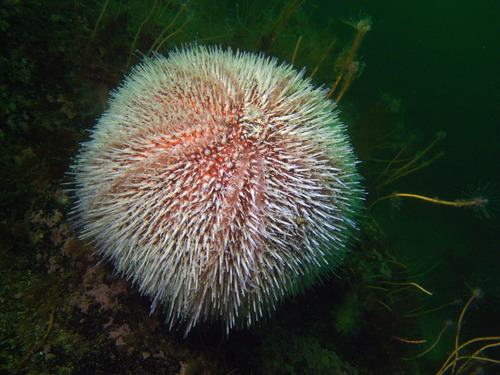
About Echinus esculentus Linnaeus, 1758
Echinus esculentus has an approximately spherical shape, slightly flattened at both poles. Its body is reddish or purplish, marked with white tubercles, and it can grow to around 10 centimetres in diameter. The brittle, rigid limy test is divided into five ambulacral areas separated by five inter-ambulacral areas. Each of these ten areas contains two rows of plates, resulting in a total of twenty rows of plates. The test is covered in spines, each of which articulates with a tubercle. There is a dense layer of smaller secondary spines, plus a smaller number of longer primary spines that grow on every second or third ambulacral plate. The spines have blunt ends and are usually white with purplish tips. A radially symmetrical pattern of holes runs through the ambulacral areas, and tube feet emerge through these holes. On the buccal plates that surround the mouth on the underside of the urchin are pedicellariae, defensive organs that resemble tiny pincers, each with two lateral teeth and one terminal tooth. This species typically reaches a diameter of 15–16 cm (5.9–6.3 in), though the largest recorded individual has a diameter of 17.6 cm (6.9 in). Within the North Sea, Echinus esculentus is common in all areas with hard substrates. It is found off the coasts of Portugal, Spain, France, Belgium, the Netherlands, Denmark, Norway, Iceland, Sweden, the United Kingdom and Ireland. The specific epithet esculentus means "edible". While sea urchin gonads (commonly referred to as roe) are used as food globally, Echinus esculentus is not a preferred edible species, because its gonads are white. Edible sea urchin species with orange gonads are preferred for consumption. It is the gonads of both male and female urchins that are eaten, not the eggs. Fishing for this species occurs off European coasts, and aquaculture of Echinus esculentus is currently being investigated. A study conducted off the west coast of Scotland found that feeding commercially available salmon feed promotes gonadal growth in the urchins, and the practicality of a full commercial farming approach for the species is currently being assessed.

