About Echinothrix calamaris (Pallas, 1774)
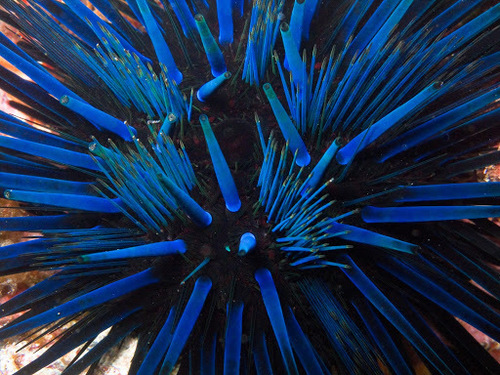
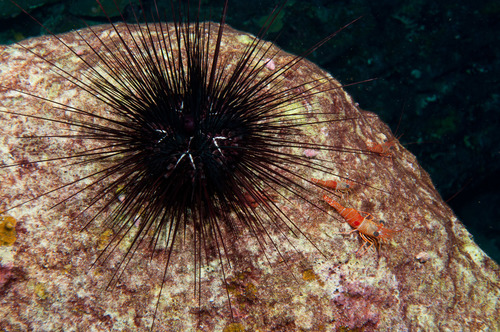
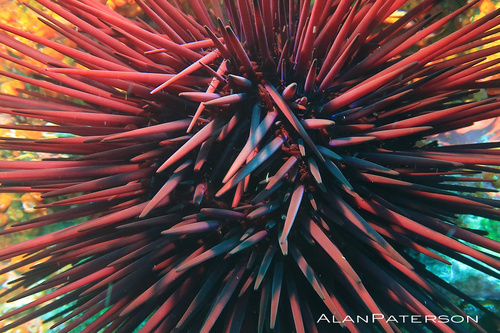
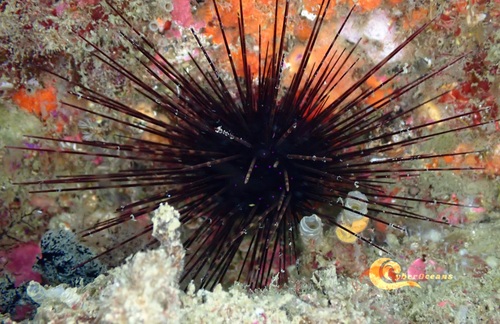
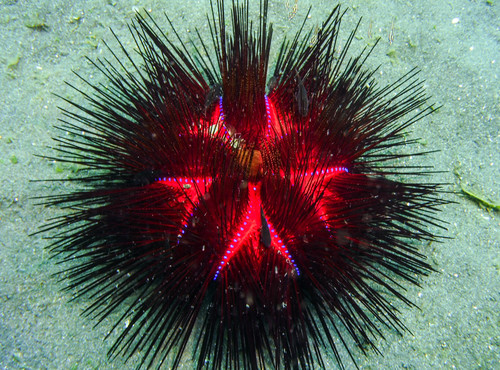
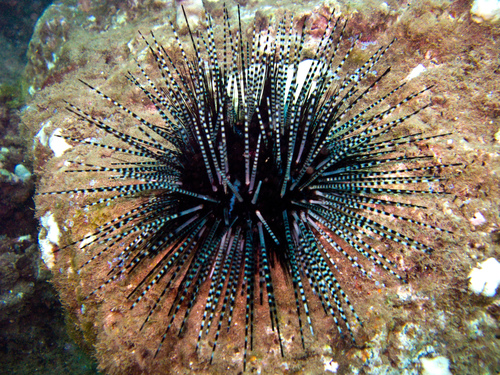
Echinothrix calamaris, commonly known as the banded sea urchin, has a slightly oval test (shell) that grows to around 5 cm in diameter. Like almost all members of the Diadematidae family—though this trait is most visible in this species—it has two distinct types of spines. The first set consists of short, slender closed spines that range in color from yellow through brown to dark, and can inflict a painful sting. The second set is made of longer, thicker spines that typically have alternating light and dark bands, though they may sometimes be entirely dark or entirely white; these longer spines can reach 10 to 15 cm in length, are hollow, and may be blunt. The spines are arranged in groups that leave five exposed, star-patterned zones called iridophores on the central area of the test. This star pattern is often colored, most commonly blue. A large, more or less translucent anal papilla is clearly visible on the aboral face; it is usually whitish, speckled with black and white dots, and surrounded by a ring of visual receptors that provide rudimentary vision. In its darkest color forms, this species can be confused with related urchins Diadema setosum and Diadema savignyi, both of which can retain banded spines as adults. However, D. savignyi is larger, more uniformly black, has less noticeable secondary spines, and can be identified by five characteristic white spots on the top of its test, along with an orange ring around its anus. The most common misidentification is with the closely related species Echinothrix diadema, which can have banded spines when young. But E. diadema has a very small, entirely black anal papilla, and its spines carry a blue sheen. The primary spines of E. calamaris are also more fragile: because they are hollow, they can be crushed between two fingers, which is not possible for the primary spines of E. diadema. The banded sea urchin is widely distributed across tropical Indo-Pacific waters, stretching from the eastern coast of Africa to French Polynesia, and including Hawaii and the Red Sea. It can be found from the water’s surface down to 70 metres (230 ft) in depth, and inhabits lagoons, external reef slopes, and channels.