About Echinocystis lobata (Michx.) Torr. & A.Gray
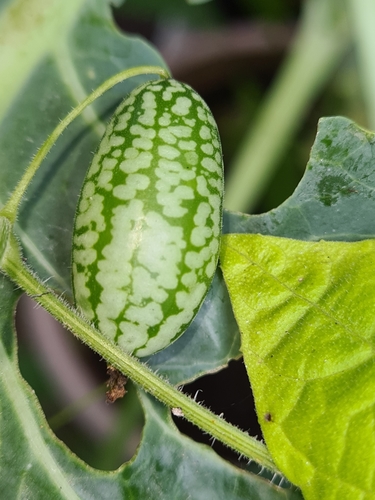
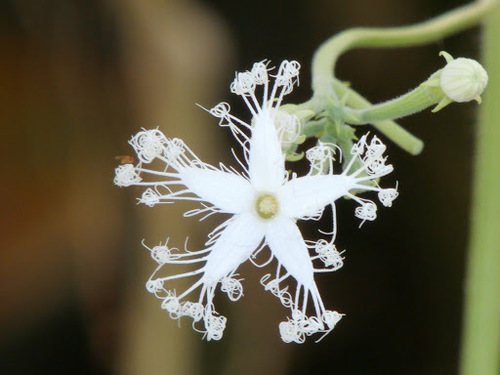
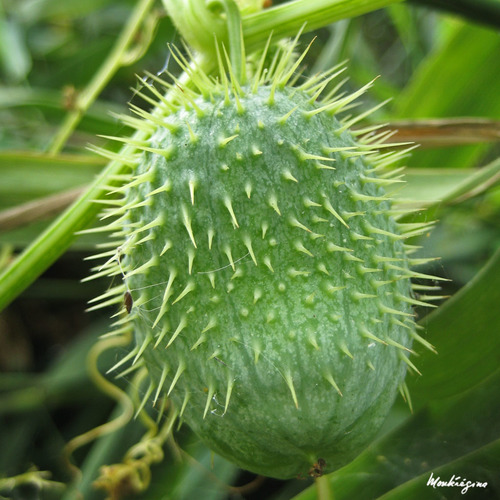
Echinocystis lobata (Michx.) Torr. & A.Gray is an annual climbing or trailing vine. Its stems reach up to 8 m (26 ft) long, and climb over shrubs and fences or trail across the ground using coiling, branched tendrils. Stems are angular and furrowed. Leaves are alternate, borne on long petioles, have five palmate lobes, and lack stipules. This species is monoecious, meaning it produces separate male and female flowers on the same individual. Male flowers grow in long-stemmed, upright panicles. Each flower has a white or greenish-yellow corolla with six slender lobes. A male flower has a single central stamen with a yellow anther. A female flower has a single stigma, grows on a short stalk at the base of the flower panicle, and has a spiky, globular inferior ovary directly beneath the flower. The fruit is a prickly, inflated capsule up to 5 cm (2 in) long, containing two pores and four seeds. It resembles a tiny spiny watermelon or cucumber, but is inedible. The fruit persists through the winter, then opens at the bottom to release its seeds. This species can be told apart from oneseed bur cucumber (Sicyos angulatus) by its six-lobed corolla and the absence of the clustered fruits that Sicyos angulatus produces. It also looks similar to Marah macrocarpa, or wild cucumber, which is a large-rooted perennial that also has a six-lobed corolla and grows in Southern California chaparral, where Echinocystis lobata does not occur. Its native range across North America covers forty U.S. states, excluding Nevada, Hawaii, Alaska, and most of the far Southeastern states, plus nine Canadian provinces. It has been documented as an uncommon invasive species in the Örség Landscape Protection Area of Hungary, near the Austrian-Slovenian border. It is also recorded as an adventive alien species that grows in wetlands, grasslands, and human-affected areas of the Carei Plain natural protected area in western Romania. Native Americans have used this plant medicinally. The Taos Pueblo of New Mexico used it to treat rheumatism, while the Menominee of Wisconsin prepared a bitter extract from its roots for use as a love potion and an analgesic. A poultice made from powdered root has been used to relieve headaches, and the seeds have been used as beads.