About Echinocyamus pusillus (O.F.Müller, 1776)
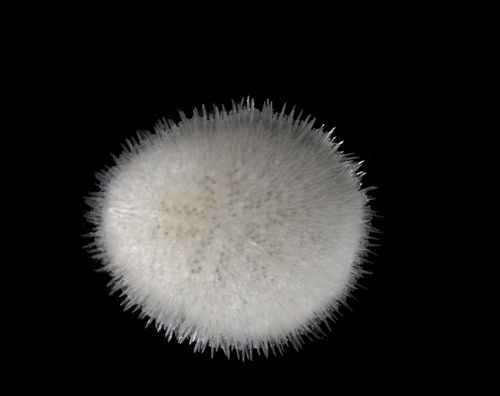
Echinocyamus pusillus is a small sea urchin with a flattened, oval body that grows up to 15 mm (0.6 in) long. Its anterior end is slightly pointed. The aboral, or upper, surface is convex, while the oral, or lower, surface is flat. Ambulacral plates widen to form a petal-like pattern on the aboral surface, and six to nine pairs of tube feet protrude through each of these areas. The entire rigid test is covered in short, dense spines, which give a living individual a furry appearance. Two types of spines are present: relatively long, sharply pointed spines, and shorter spines with serrated tips. The mouth is located in the center of the oral surface, and the anus is also on the oral surface, positioned further back. This sea urchin is greenish or yellowish-grey in colour, and turns bright green when injured.
Echinocyamus pusillus has a wide distribution in the northeastern Atlantic Ocean. Its range extends south from Iceland, Norway and Denmark to the Azores, Cape Bojador in Western Sahara, and the Mediterranean Sea. It is common in the North Sea and around the coasts of Britain. It occurs at depths from the lower subtidal zone down to approximately 1,250 m (4,000 ft). It buries itself in suitable habitat of gravel and coarse sand.
The spines of Echinocyamus pusillus are covered in fine, hair-like cilia, and are used for burrowing or creeping through sediment as the animal searches for food. It feeds on detritus, Foraminifera, diatoms and other edible particles. It uses its tube feet to move these food items to its mouth, where the jaws crush them, separating organic matter from sediment. It is often found living alongside other marine invertebrates including the sea urchins Spatangus purpureus and Psammechinus miliaris, the starfish Asterias rubens, and the brittle star Ophiura albida.

