About Echinocereus triglochidiatus Engelm.
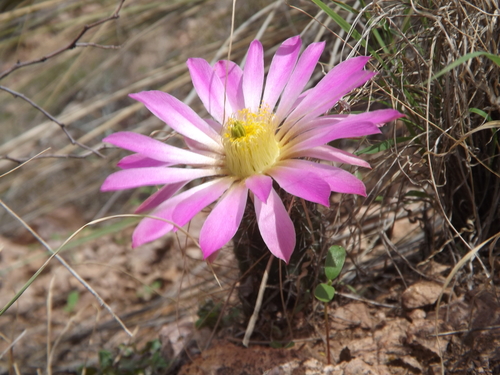
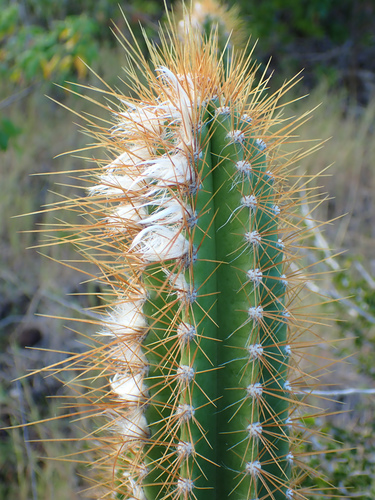
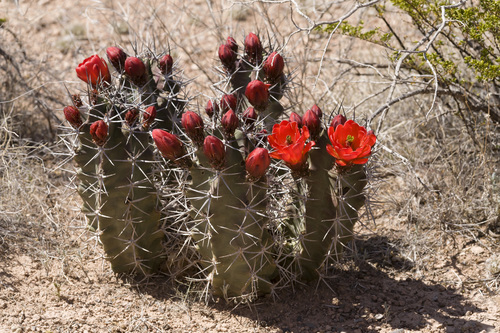
Echinocereus triglochidiatus Engelm. is a highly variable cactus species with multiple known varieties, though not all of these varieties are universally recognized. Most commonly, it grows as a mounding cactus, forming bulbous piles of stems that range from spherical to cylindrical, and vary in color from light green to bluish green. Mature growth forms cushions over 1 meter in diameter that can hold up to 500 individual shoots. Stems measure 5 to 40 cm long and 5 to 15 cm in diameter, and have 5 to 12 ribs that are either straight-edged or tuberculated. The cactus is densely spiny and somewhat woolly. It produces 1 to 4 central spines that resemble its peripheral spines, and up to 22 marginal spines that can be round or flattened, range in color from yellow to dark, grow 1 to 7 cm long, and are occasionally absent. Its showy flowers are funnel-shaped, up to 8–9 cm (3.1–3.5 inches) wide, and have bright scarlet red to orange-red tepals. The center of the corolla holds a thick nectar chamber and many thready pink stamens. Fruits are spherical to obovate, slightly pink or reddish, and shed their thorns as they mature. The chromosome count for this species is 2n = 22. All varieties of E. triglochidiatus occur in the Southwestern United States, growing across a range of upland, mountain, and desert habitats in Arizona, New Mexico, Colorado, California, Texas, and Northern Mexico, at elevations between 150 and 3500 meters. Hummingbirds favor this cactus for pollination, but its flowers are not specialized for hummingbird pollination, and bees also pollinate the species. Seeds are dispersed from the fruits of mature plants. While ants sometimes carry fruits to their mounds and leave seeds exposed above ground to sprout, feeding by rodents and lagomorphs is the most common method of seed dispersal. New cactus sprouts grow best under the shade of fourwing saltbush, which protects young plants from animals and desiccation. New growth of E. triglochidiatus clusters around very old specimens, growing on top of the remains of the saltbushes that acted as nursery plants. Rodents occasionally kill mature cacti by digging nests underneath the plants and destroying their roots.