About Echinocereus dasyacanthus Engelm.
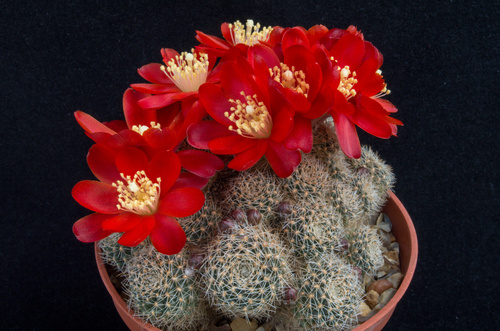
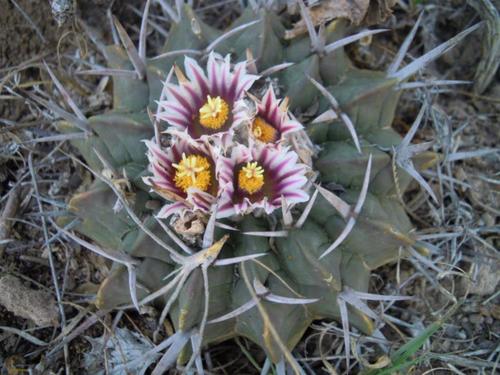
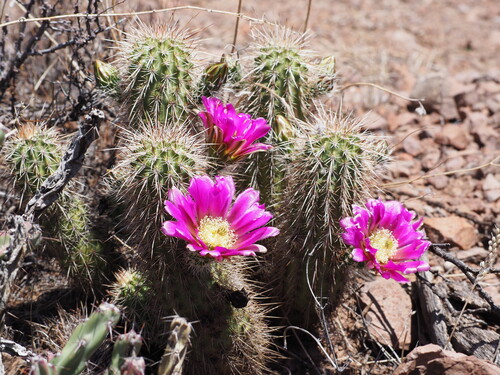
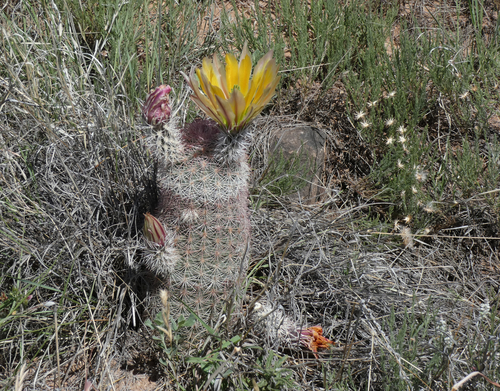
Echinocereus dasyacanthus Engelm., commonly called the Texas rainbow cactus, most often grows with a single stem or 2 to 3 basal branches, though it is not unusual to find specimens with 3 to 10 stems. Mature stems measure 11 to 24 cm long and 5.5 to 7 cm wide, and typically have 15 to 18 ribs. Spines usually overlap one another, completely obscuring the underlying stem. Spine characteristics vary widely across the species: plants typically have 4 to 12 central spines 0.5 to 1.2 cm long, and 14 to 25 radial spines 0.7 to 2 cm long. The most common spine colors range from tan to yellow to pink; less common variation includes spines that are ashy-white to reddish brown. This cactus grows on rocky arid mountain slopes, desert floors, desert grasslands, and in more mesic habitats. It is distributed across New Mexico and Texas in the United States, occurring in every county of Texas's Trans-Pecos region except Val Verde. Its range extends south into the Mexican states of Chihuahua and Coahuila. Echinocereus dasyacanthus is grown as an ornamental plant, used in desert native plant natural landscaping, kept as a houseplant, and grown in greenhouses. As a smaller cactus species, it is relatively easy to care for. It requires little to no maintenance, needs minimal water, and grows well in full sunlight to partial shade. It can grow in regular soil or rocky sandy substrate. Its seeds germinate anywhere between 5 and 180 days.