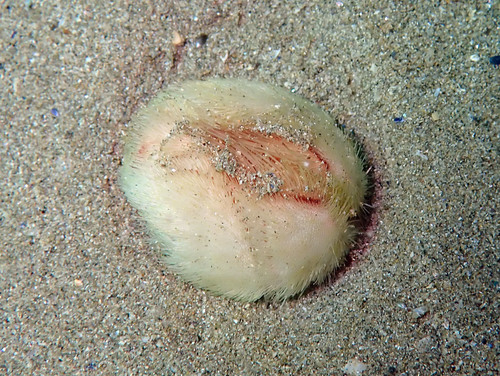
About Echinocardium cordatum (Pennant, 1777)
Commonly called the sea potato, Echinocardium cordatum is a heart-shaped sea urchin covered in a dense layer of furrowed yellowish spines. These spines grow from tubercles and mostly point backwards. Its upper surface is flattened, with an indentation near the front. Living individuals are fawn-colored, while empty tests (skeletons) found on strandlines usually have lost their spines and appear white. When the urchin is alive, its spines trap air to prevent asphyxiation while it is buried. The ambulacra form a broad, star-shaped furrow that extends down the sides of the test, with two series of two rows of tube feet each. The test measures 6 to 9 centimetres in length. The sea potato has a discontinuous cosmopolitan distribution. It has been recorded in temperate seas of the north Atlantic Ocean, west Pacific Ocean, around Australia, New Zealand, South Africa, and the Gulf of California, at depths down to 230 metres. A 2016 study found that Echinocardium cordatum is actually a species complex made up of at least 5 distinct species: three in Europe, one in Australia, and one in the northwest Pacific. It is very common around the coasts of the British Isles in the neritic zone. The sea potato favours sandy seabeds, where it is often found living alongside the bivalve molluscs Tellina fabula, Ensis ensis, and Venus striatula. The bivalve Tellimya ferruginosa is a common commensal that lives inside the sea potato's burrow. Up to fourteen individuals of this bivalve have been found in a single burrow; young bivalves attach to the urchin's spines with byssus threads. The amphipod crustacean Urothoe marina also commonly uses the sea potato's burrow.

