About Echinaster spinulosus Verrill, 1869
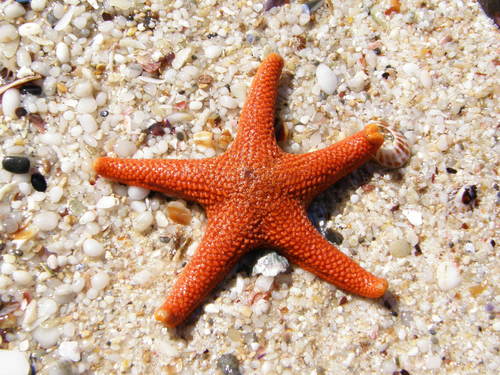
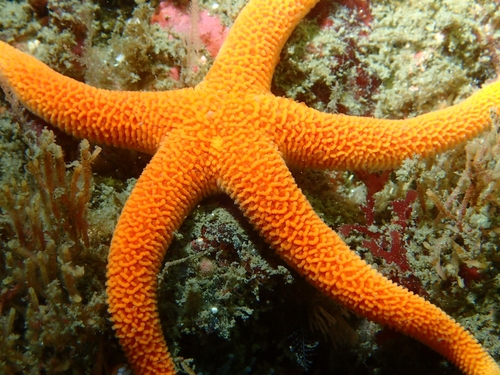
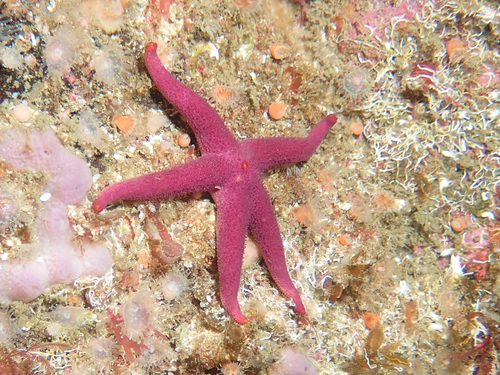
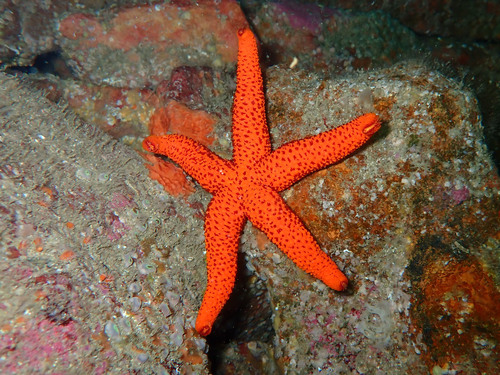
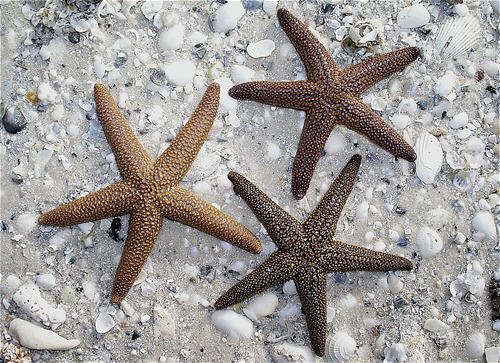
Echinaster spinulosus Verrill, 1869 is a medium-sized sea star with five long, tapering, round-in-cross-section arms connected to a central disc. The madreporite, a structure that draws in water to replenish the water vascular system, sits near one edge of the central disc. Its upper (aboral) surface is covered in prominent flat plates, each of which holds several short, blunt spines. These plates have fine granulations, and are arranged into 15 to 20 irregular rows that run down the length of the arms. A row of plates with flattened spines lines the margin of each arm. On the lower (oral) surface, larger plates sit on either side of the ambulacral grooves; each of these plates holds one small spine and two larger spines. The ambulacral grooves contain several rows of bright orange tube feet equipped with suckers. Tiny orange eye spots sit at the tips of the arms, and these tips are often turned upwards. This sea star reaches a maximum diameter of about 6 inches (150 mm), and its overall body color is maroon or brown, flecked with white. The body wall of the central disc and arms is made of collagen fibers arranged into a three-dimensional web, with calcareous plates positioned between the fibers. This structure creates a protective surface that is flexible during movement, while providing rigidity when needed. Echinaster spinulosus occurs in the western Atlantic Ocean, ranging from Cape Hatteras and the Gulf Coast southward to Venezuela, and including the Caribbean Sea and the Gulf of Mexico. Its typical habitats are sandy bottoms, seagrass meadows (Zostera spp.), oyster beds, stony flats, and pilings. It is a common species, found at depths between 10 and 20 metres (33 and 66 ft).