About Echinacea paradoxa (Norton) Britton
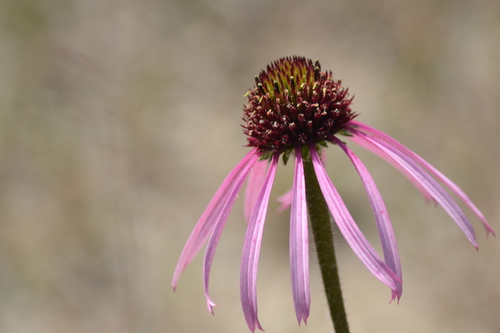
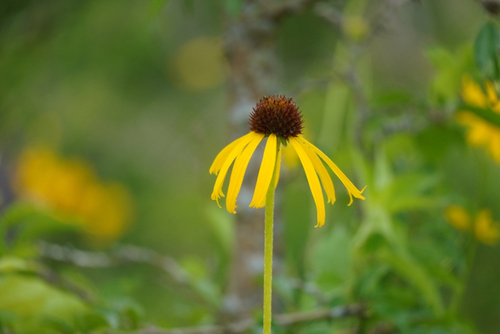
Echinacea paradoxa (Norton) Britton is a perennial herb that grows up to 90 cm (3 ft) tall. It produces multiple slightly hairy stems that grow from its rootstock. Most of its leaves are basal leaves with smooth edges; leaves are arranged alternately along the stem, growing shorter further up the stem, and are completely absent from the upper two-thirds of the stem. Basal leaves measure 8–45 cm (3–18 in) long, and are shaped from narrowly elliptic to lanceolate. Stem leaves measure 4–35 cm (2–14 in) long, and are shaped from linear to narrowly elliptic or narrowly lanceolate. A single plant can produce several flower heads. Each flower head is about 5–6 cm (2–2.5 in) across, with white, pink, or yellow ray florets surrounding a central dome-shaped head of many small disk florets. The central head is dark reddish brown to nearly black, prickly to the touch, and the species blooms in May and June. Echinacea paradoxa var. paradoxa, commonly called yellow coneflower, is endemic to the Ozarks of Missouri and Arkansas, and is listed as imperiled in Arkansas. Echinacea paradoxa var. neglecta, commonly called Bush's purple coneflower, is currently only known to grow wild in the Arbuckle Mountains region of southeastern Oklahoma. One isolated population was previously reported from Montgomery County in eastern Texas. This variety is listed as critically imperiled in Oklahoma and presumed extirpated in Texas. Habitats where this species grows include partially sunny to full sun savannas, glades, limestone outcroppings, barrens, open hillsides, and bald knobs.