About Echinacea laevigata (C.L.Boynton & Beadle) S.F.Blake
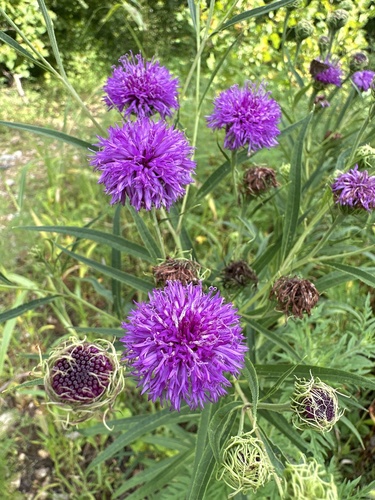
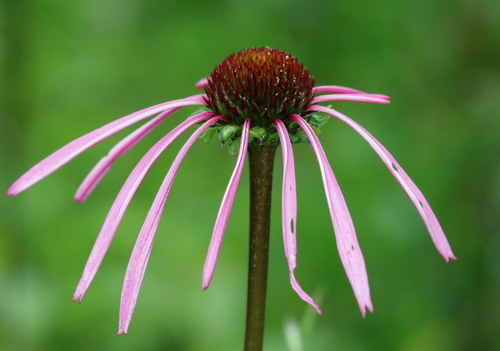
Echinacea laevigata, the smooth purple coneflower, is a rhizomatous perennial herb that closely resembles its relative the common purple coneflower (Echinacea purpurea). The two species can be distinguished by their leaves: common Echinacea purpurea has heart-shaped leaves, while Echinacea laevigata has leaves that are roughly lance-shaped. Echinacea laevigata grows to around 1.5 meters (5 feet) tall, and produces a mostly bare, smooth, nearly leafless stem. A single flower head sits atop the stem, bearing narrow pink or purplish ray florets that can reach 8 centimeters (3.2 inches) long; these florets droop away from the center of the flower head. The small, tubular disc florets that fill the center of the head are dark purple. This species blooms from May through July. It produces a dry achene fruit around half a centimeter long, which is likely dispersed by birds and small mammals that collect the achenes to eat. Vegetative reproduction has been observed, with multiple stems growing from a single shared rhizome or shared aboveground leaf rosette. The natural habitat of Echinacea laevigata is sunny openings within forested landscapes. Historically, these open areas were created by wildfire, intentionally set fires from Native American groups, and animal grazing activity. This species prefers soils that are rich in calcium and magnesium, including soils formed from limestone, marble, gabbro, and diabase. Common species that share its natural habitat include eastern red cedar (Juniperus virginiana) and rattlesnake master (Eryngium yuccifolium). Several oak species are also present in these habitats, but they are stunted, allowing sunlight to reach the understory where Echinacea laevigata grows. After human activity reduced the extent of intact open forest habitat in the region, this species survived in other open, sunny habitat types, including cedar barrens, clearcuts, roadsides, cleared areas around utility infrastructure, and limestone bluffs. Two-thirds of the populations known since this species was first formally described have now been lost. Echinacea laevigata is pollinated by a wide range of insects, including the Western honeybee (Apis mellifera), bumblebees (Bombus spp.), the bees Psithyrus citrinus and Xylocopa virginica, multiple butterfly species, and the milkweed bug Lygaeus kalmii. The current distribution of Echinacea laevigata is limited to the U.S. states of Virginia, North Carolina, South Carolina, and Georgia. Historically, it was also found in Pennsylvania and Maryland. This species has been rare since it was first documented, but a variety of human activities have reduced its range further. Today there are around 100 known occurrences of the species, and many of these occurrences are in poor condition. The total area of suitable habitat for this plant has decreased dramatically, and this loss continues.