About Echidnocerus cibarius White, 1842
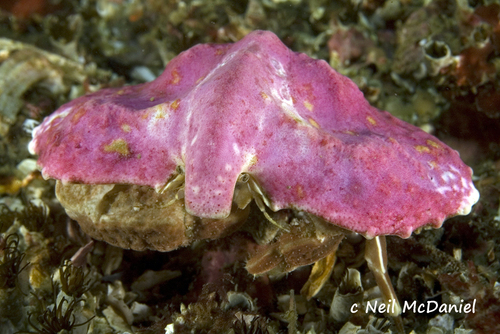
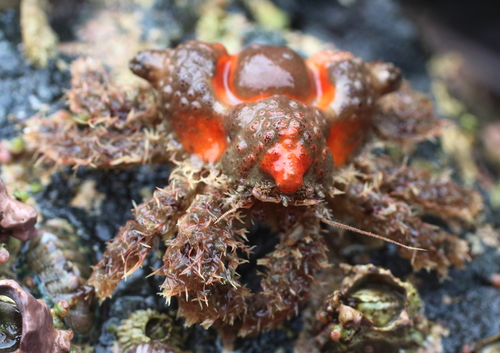
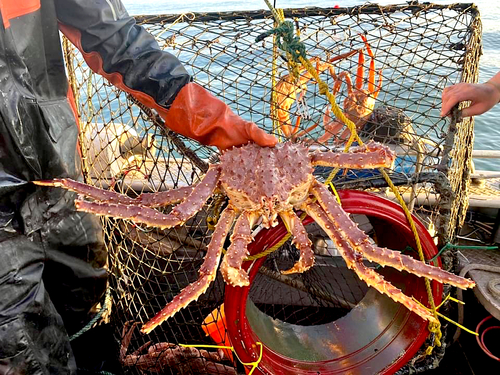
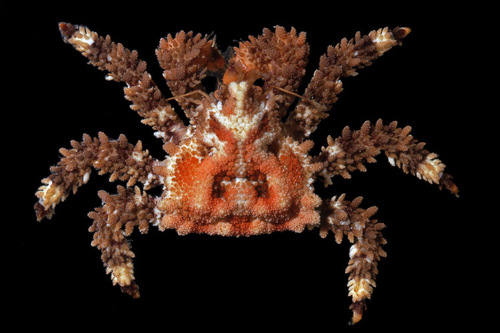
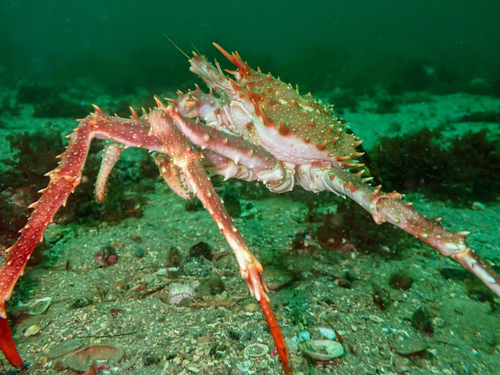
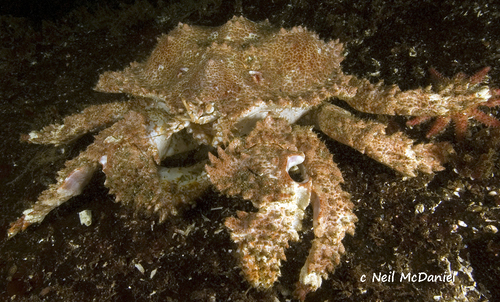
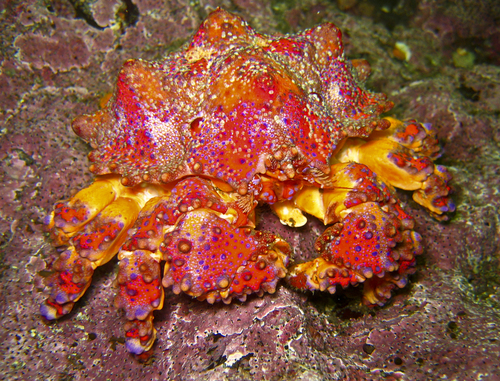
Echidnocerus cibarius White, 1842, commonly called the Puget Sound king crab, is an uncommon species of crab found along the West Coast of the United States, ranging from Alaska to Central California. Juvenile Puget Sound king crabs are primarily orange, with scattered patches of red and purple. When they reach adulthood, their shell develops a mixed coloration of red, orange, and purple. Adults reach an average size of 6–10 inches (15–25 cm), and the carapace (the dorsal section of the exoskeleton) can grow to more than 12 inches (30 cm) wide. This makes the Puget Sound king crab one of the largest crab species on the West Coast of the United States, while also remaining one of the hardest to find. A key characteristic of E. cibarius is the covering of blunt, rounded bumps across its body. This physiological trait helps the species conceal itself in subtidal habitats, and also distinguishes it from closely related species. For example, the brown box crab Lopholithodes foraminatus has much sharper, spine-like protrusions rather than the blunt bumps of the Puget Sound king crab. E. cibarius is distributed along the Pacific Coast of the United States, with confirmed observations ranging from Montague Island, Alaska to Monterey, California. In this range, the Puget Sound king crab lives near many other closely related species, including Alaskan king crab. This species can be found from the subtidal zone down to depths of approximately 140 meters. It most often occupies rocky areas, where it can maneuver easily and hide from strong currents and drag that can displace other organisms. Juvenile Puget Sound king crabs are more commonly found under rocks at low tide to avoid heat stress, making juveniles easier to find than adults. Adult Puget Sound king crabs spend most of their time at lower depths, where they are more likely to catch prey. The only exception is during late winter and early spring, when adults move up into shallow waters to mate and breed. Recently, E. cibarius has become less common in the Puget Sound Straight region of Washington, USA, due to shoreline modifications that negatively impact the shared habitats where this species coexists with many others.