About Echidna nebulosa (Ahl, 1789)
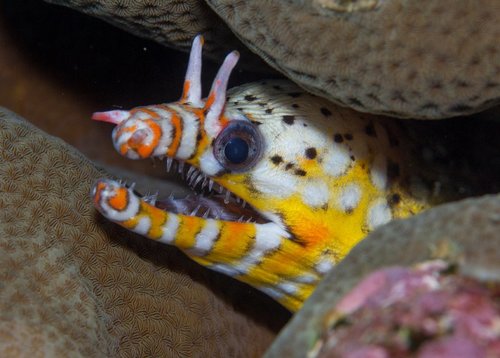
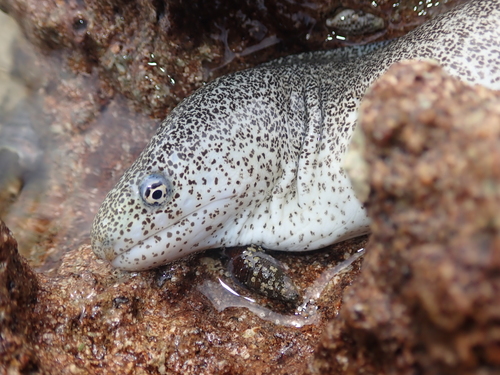
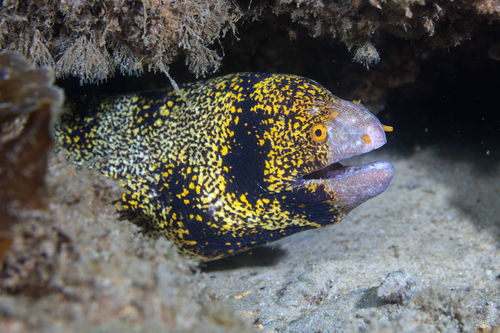
Description and biology: The snowflake moray, Echidna nebulosa, has a blunt white snout that transitions into a speckled pattern of yellowish, brown, and black stripes. A single dorsal fin runs the entire length of its body. Two yellow tubular nostrils that angle downward protrude from its snout, and an additional pair of nostrils sits closer to its eyes. Like other moray eels, the snowflake moray has poor eyesight, which is compensated for by a heightened sense of smell. Its teeth are small and blunt, rather than sharp, and its diet consists mainly of crustaceans. Along with other moray eel species, the snowflake moray has pharyngeal jaws — a second set of jaws located in the throat or pharynx. This species is an unconfirmed protogynous hermaphrodite, meaning it is capable of changing sex during its lifetime. Snowflake morays are scale-less; they secrete mucus over their skin to allow easier maneuverability in and out of holes in their environment. This species can grow up to 100 centimeters (39 inches) in total length, but individuals are most commonly found at 50 centimeters (20 inches). Distribution: This species is distributed across the Indo-Pacific, ranging from the eastern coast of Africa (including the Red Sea) through Micronesia, and extending as far east as Hawaii. It is also found in the eastern Central Pacific, from southern Baja California, Mexico, and from Costa Rica to northern Colombia. Habitat: The snowflake moray most often resides in seagrass beds with rock rubble, rocky shallows, intertidal reef flats, and tide pools. It lives at depths between 1 meter and 48 meters.