About Echidna catenata (Bloch, 1795)
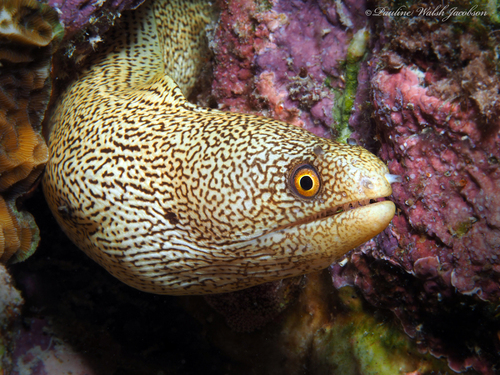
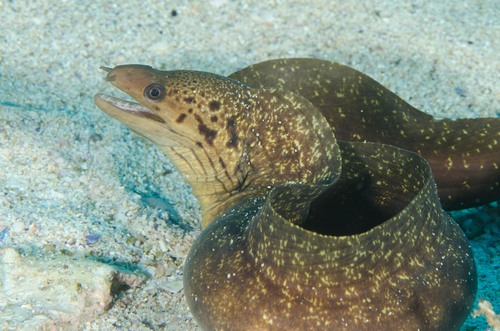
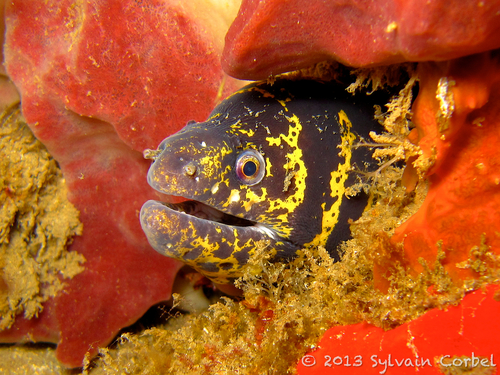
The chain moray, Echidna catenata, is an elongated, heavy, eel-like fish that typically reaches a length of 30 to 45 cm (12 to 18 in). It has a rounded snout and pointed, blunt teeth, particularly on the roof of the mouth. These blunt teeth are adapted for crushing the shells of crabs, which are the main component of its diet. Its dorsal, tail, and anal fins are fused into a single long fin, and it has no pectoral or ventral fins. Its skin is scaleless and covered in a layer of clear mucus. The fish's body is dark brown to black, patterned with an interconnecting, chain-like lattice of yellow lines, and it has yellow eyes. The chain moray occurs in the western Atlantic Ocean, with a range that extends from Bermuda, Florida, and The Bahamas, to the Antilles and Brazil. It is common in the Caribbean, and has also been recorded from the eastern Atlantic around Cape Verde and Ascension Island, as well as some southern Atlantic islands. It inhabits reefs and rocky shores in clear water, at depths of less than 12 m (39 ft), and is usually found within 2 m (6.6 ft) of the surface. The chain moray is mainly nocturnal. During the day, it hides in shallow water holes and crevices, often with its head protruding from the hiding place. It repeatedly opens and closes its mouth to boost water flow over its gills. As a carnivore, aside from crabs its diet also includes shrimps, worms, octopuses, and small fish. It does not always leave its hiding spot to forage, and will sometimes stay in place to ambush passing prey. It may forage in tide pools, and can survive out of water for up to half an hour. In addition to ambushing, it uses other feeding strategies: it searches for prey under pool rims, beneath rocks, and in holes; it stalks observed prey or chases it for distances up to 5 m (16 ft). When it gets within 5 to 10 cm (2 to 4 in) of its prey, it strikes, and can perform this strike even when part or all of its body is out of water. After capture, large crabs are torn apart, while small crabs are swallowed whole.