About Echeveria agavoides Lem.
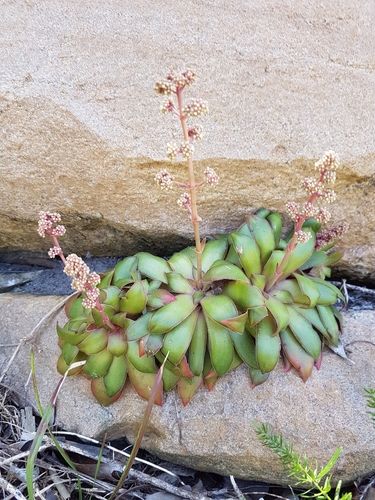
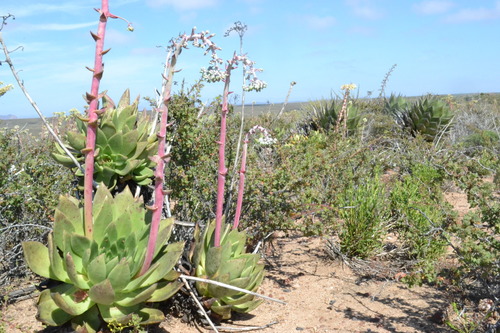
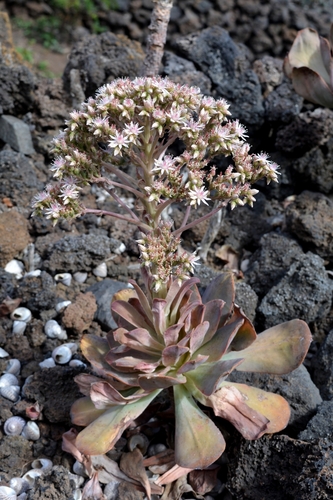
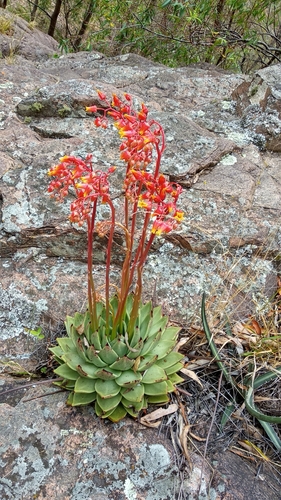
Echeveria agavoides Lem. is a small, stemless succulent that grows 8–12 cm (3.1–4.7 in) tall, with a leaf rosette 7–15 cm (2.8–5.9 in) across. It most often grows alone, but mature healthy plants produce offsets. Its leaves are green and triangular, and are thicker (measuring 6 mm) and more sharply pointed than leaves of other echeverias. This trait gives the species its specific epithet agavoides, meaning "looking like an agave". Some varieties grown in bright light develop reddish or bronze leaf tips, and some forms have leaf margins ranging from lightly tinted red to fully red. In summer, it produces inflorescences on slender, single-sided cymes that can reach up to 50 cm (20 in) long. Its flowers are pink, orange, or red, with petals that end in dark yellow tips. Like most echeverias, E. agavoides can be damaged by excess moisture, and prefers mineral soils. It grows best in bright light, even full direct sun, which supports healthy flowering. To encourage flowering, plants need a dormant winter rest period kept cool and dry, with temperatures not dropping below 5 °C (41 °F). In temperate regions, this species must be kept indoors through winter, but can be moved outdoors during summer. It has been awarded the Royal Horticultural Society's Award of Garden Merit. Many hybrids of E. agavoides have been created to produce more intensely colored flowers or leaves. The simplest propagation methods are leaf cuttings and division of mature plants. It can also propagate easily from stem cuttings, though propagation from leaf cuttings is often more challenging. To propagate, a sharp, sterilized knife or pair of scissors must be used to cut the stem or leaf tissue. The cut section must be left to callous over before it is replanted.