About Echeneis neucratoides Zuiew, 1789
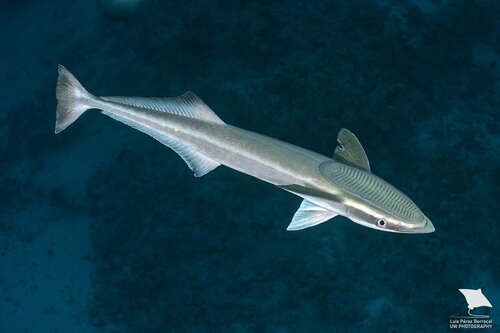
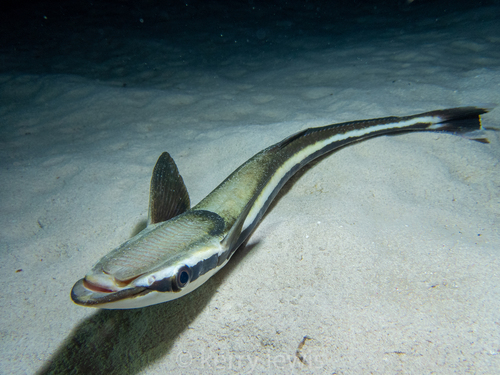
Echeneis neucratoides is a slender remora that reaches a maximum total length of around 75 centimeters (30 inches). This species has bands of small, sharp teeth in both jaws, additional tooth bands on the vomer and palate, and granular teeth covering the tongue. A large oval sucker sits on the top of its head; this structure develops from a modified front dorsal fin, and the fish uses it to attach itself to host fish. This sucker holds between 18 and 22 lamellae, which is fewer than the 23 to 28 lamellae found in the closely related species Echeneis naucrates. The pelvic fins of Echeneis neucratoides have narrow bases, while the pectoral fins have moderately pointed tips and are made up of 22 rays. The hind dorsal fin has 32 to 41 rays, and the anal fin has 30 to 38 rays. The dorsal surface of this fish is dark brown to black, and it also has a broad, dark longitudinal lateral stripe that runs from the eye, through the pectoral fin, all the way to the caudal peduncle. The rest of the fish’s body is silvery-grey. The dorsal, pectoral, and caudal fins are dark with whitish margins, and the whitish margins are most prominent on the front sections of these fins. This fish is found in the subtropical western Atlantic Ocean, the Caribbean Sea, and the Gulf of Mexico. Its range falls within coordinates bounded by 43°N to 4°N latitude and 98°W to 51°W longitude, stretching from Massachusetts to the northern coast of South America, and includes the Bahamas and the Antilles. It is most commonly associated with reef habitats, but it can also be found further offshore. Echeneis neucratoides is sometimes free-swimming, but it often uses its head sucker to attach itself to host animals such as sharks, other large fish, or turtles. Like other remoras, it often feeds on scraps of food left behind by its hosts, and it may also eat parasitic copepods that live on the host’s skin.