About Eccremocarpus scaber Ruiz & Pav.
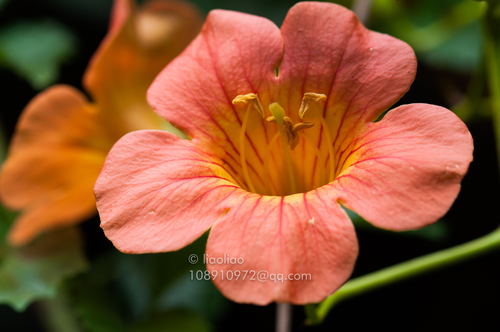
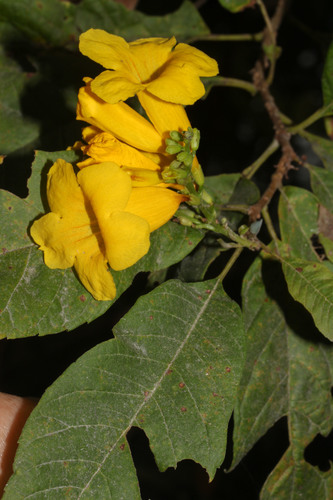
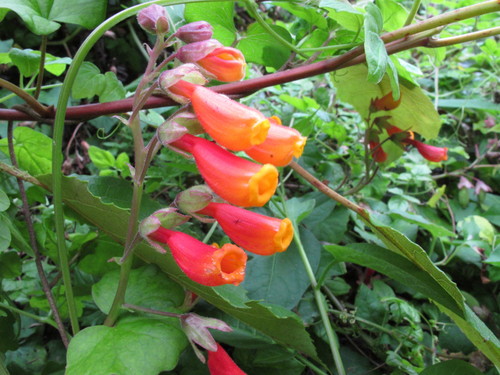
Eccremocarpus scaber Ruiz & Pav., commonly called Chilean glory creeper, is a many-branched perennial vine or climbing shrub with a woody base. It is evergreen in mild climates, and deciduous in colder climates. It has thin, alternate pinnate leaves with light green leaflets. Leaves may bear small fine hairs, but are mostly glabrous. Leaf stalks are 2 cm long; younger stems hold 2 leaflets, while older stems hold 3 to 7 leaflets. Leaflets are oval in shape with distinct pinnate venation, and leaf size can vary. Tendrils can hook onto surrounding structures to gain grip and structural support for climbing. Flowers have a tubular structure, with rounded petals that recurve at the tip. Flowers have bright orange-red outer portions and a red center; cultivated varieties are also available with pink, yellow, or deep scarlet flowers. Flowering occurs from September through May, or from late spring through autumn, and can begin in the first year if plants are planted early. After flowering, it produces a glossy, oval, wrinkled fruit capsule that measures roughly 4.5 cm in height and 2 cm in girth. Each capsule contains black seeds with a prominent wing that aids wind dispersal. The plant can also spread via stem fragments. It is native to Chile (including the Chilean Andes), Peru, Colombia, and Ecuador in the Americas, and has become naturalized in Mediterranean Europe with tropical climates. It prefers forest edges, roadsides, and waste areas with abundant sunlight and good drainage, though it can tolerate some shade. It grows best in warmer, well-drained sites with soil pH between 5.5 and 7.5. It is not winter hardy and cannot tolerate excessively cool climates. In New Zealand, it occurs in the North Island, and in warmer regions of the South Island including Canterbury, Southland, and Central Otago. It is classified as a weed under New Zealand's National Pest Plant Accord, due to its rapid growth, heavy seed production, and tendency to grow over and smother smaller plants, including native species. Despite being considered a weed in New Zealand, it is commonly grown as an ornamental plant. In New Zealand, it is often grown as an annual, though many gardeners in other regions also grow it as an annual even though it is a perennial. Germination takes around 8 weeks at temperatures of 16 to 21 °C. It can grow 8 to 10 feet in a single growing season. Flower clusters are 4 to 6 inches long, with typically four flowers per cluster. Young plants are not hardy enough to survive harsh winters, but if their roots are shaded by other plants and their upper growth receives adequate sun, the top growth may die back (though foliage can sometimes survive winter) and the plant will re-emerge larger and stronger the following year.