About Ecballium elaterium (L.) A.Rich.
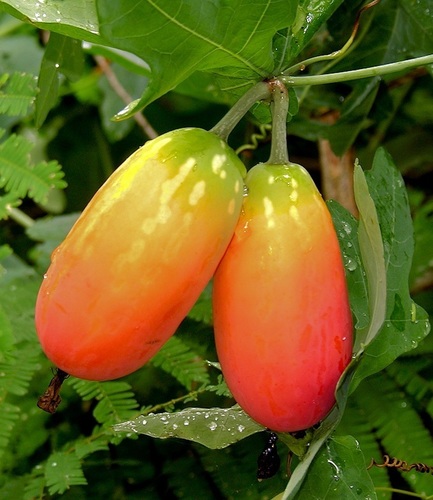
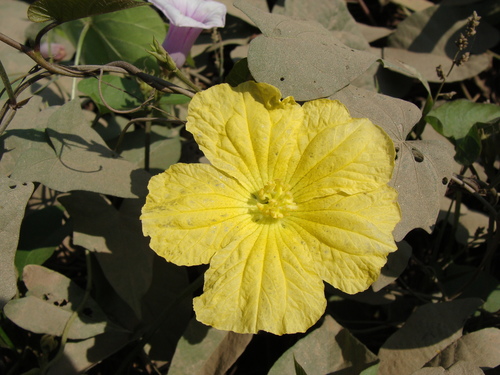
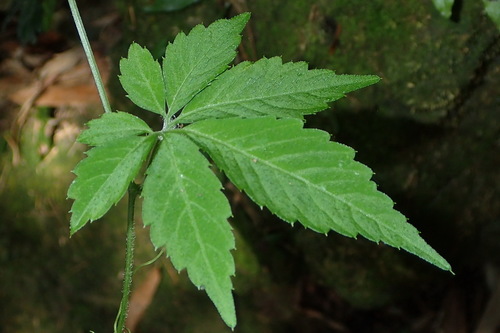
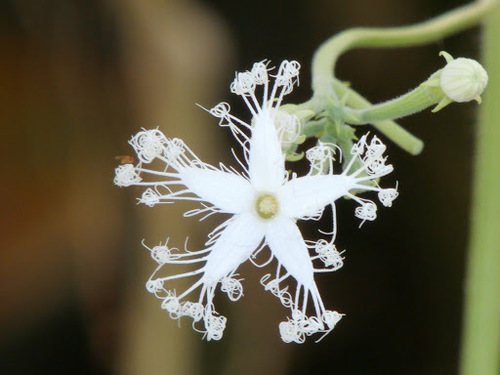
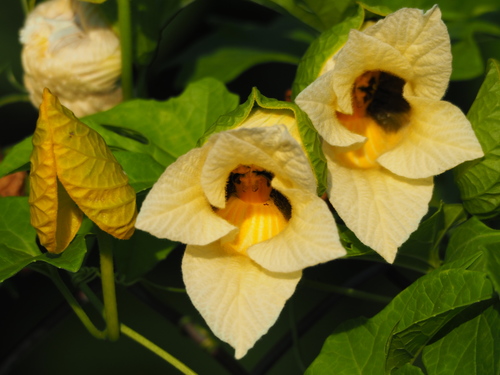
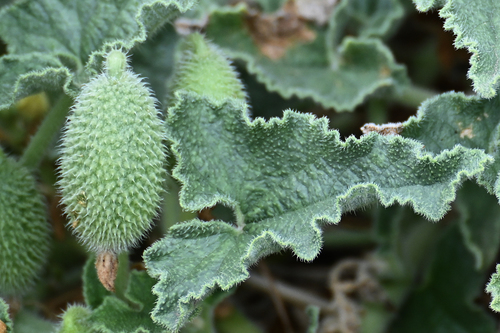
Ecballium elaterium (L.) A.Rich. is a herbaceous perennial plant with a tuberous root. It most often trails along the ground, but may sometimes take a shrubby form, and has bristly stems. Its leaves are lobed, greyish-green, with rough surfaces and bristly hairs. Its flowers have a five-lobed yellow corolla, measuring 2–5 cm (0.79–1.97 in) across. After flowering, they develop into an oval green or blue-green fruit around 5 cm (2.0 in) long, which looks like a small, hairy cucumber. Ecballium elaterium is native to southern Europe, northwestern Africa, and southwestern Asia. It is cultivated as an ornamental plant in other regions, and has become locally naturalized in Australia, central and western Europe, central Asia, New Zealand, and eastern North America, where it is classified as an invasive species. Elaterine is a cucurbitacin extract obtained from the fruit juice of Ecballium elaterium, and it was used as a purgative in folk medicine since ancient times. The concentrated fruit juice extract, called elaterium, was first identified by Stirling in 1835. Elaterin is extracted from elaterium using chloroform, then precipitated with ether; it has the chemical formula C32H44O7, and forms colorless scale-shaped crystals with a bitter taste. It is confirmed to be poisonous when consumed through the nose or mouth. A preparation called Pulvis Elaterini Compositus was once included in the British pharmacopeia. According to the 11th edition of the Encyclopædia Britannica, the effects of this extract are similar to saline aperients, but much stronger. It is described as the most active known hydragogue purgative, and it also causes significant depression and severe griping pain. When injected subcutaneously, it has no effect, because its action depends entirely on mixing with bile. The extract was considered clinically valuable for treating dropsy, Bright's disease, and both existing and threatened cerebral haemorrhage. It was recommended to only be used in urgent cases, and always handled with extreme caution, especially when a patient has poor heart function. In the 21st century, elaterium and its components are officially recognized as poison, with multiple published case reports of hospitalization, uvula edema, and nasal mucosa necrosis resulting from nasal or oral consumption.